
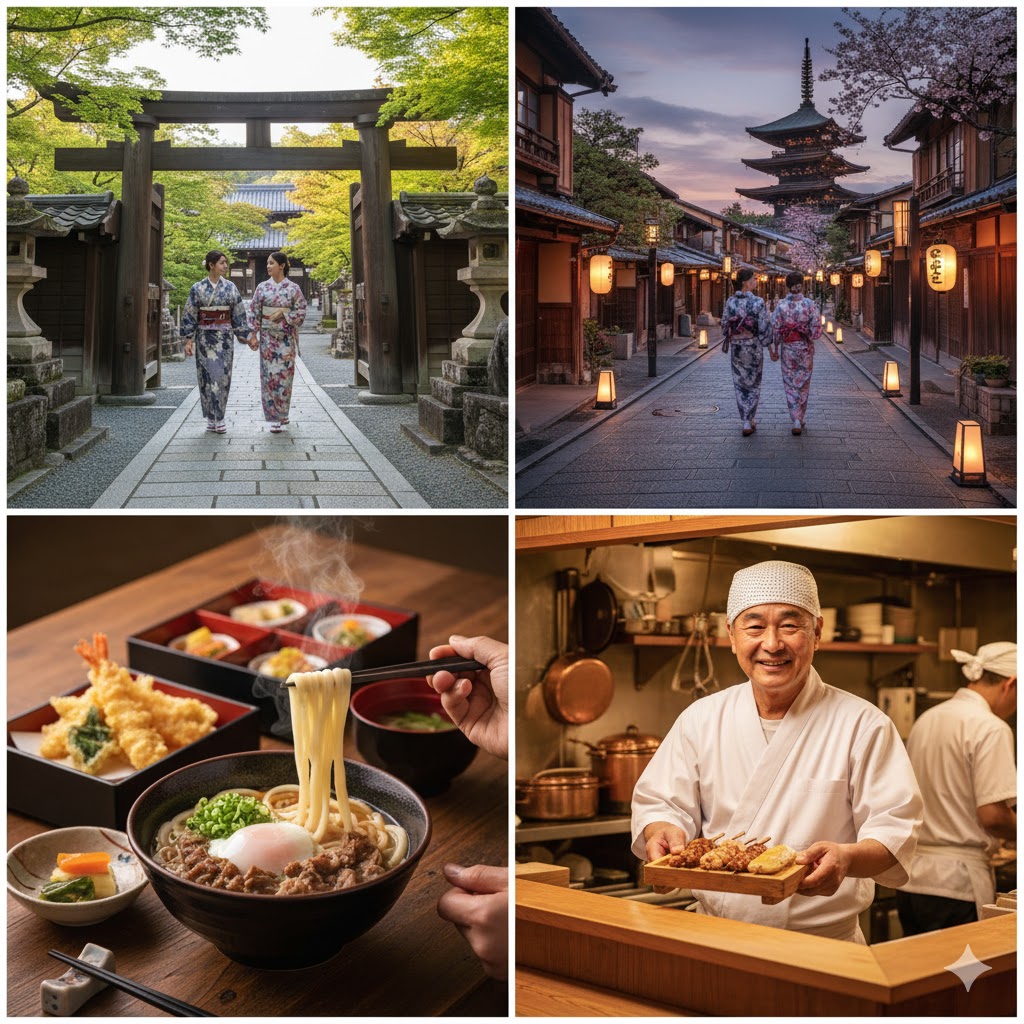
1. Introduction: A Kyoto Morning Awakens
The alarm on your phone reads 6:47 AM when you first hear it—not the alarm, but the distant gong of a temple bell echoing across Kyoto’s rooftops. Morning mist clings to the traditional wooden buildings below your hotel window. The city is still quiet, still sleeping. This is when Kyoto reveals its truest self: before the crowds arrive, before the modern world intrudes, when the ancient capital feels genuinely magical.
You pull on comfortable walking shoes and step into the cool spring air. Already, you can smell it—that distinctive blend of earth and incense and something unmistakably Japanese that you can’t quite name. Your stomach rumbles. You haven’t eaten yet, but that’s intentional. Today, you’re not just visiting Kyoto. You’re feeling it. You’re walking where samurai walked, praying where monks pray, eating where locals eat, and ultimately, discovering that the true essence of Japan exists at the intersection of spirituality, beauty, and food.
This is your perfect day in Kyoto. Let’s begin it properly—with temple bells and gratitude.
2. Morning: Explore & Experience the Sacred
2-1. 6:30 AM – Fushimi Inari Temple: Arriving Before the Crowds
Most visitors never experience Fushimi Inari as it should be experienced. They arrive at 10 AM with thousands of others, shuffling through crowds photographing the famous vermillion torii gates. But you’re different. You’re arriving in near-darkness, headlamp in hand, following the winding paths where pilgrims have walked for over 400 years.
Fushimi Inari isn’t just beautiful—it’s transcendent in these early morning hours. The thousands of vermillion torii gates seem to glow softly in the emerging dawn. Your footsteps echo alone through the tunnels. Prayer cards flutter in the breeze. Every few minutes, you encounter a solo pilgrim or devotee, but mostly, you have the space to yourself. This is what the temple was designed for: quiet contemplation, personal spiritual connection, the sensation of walking between worlds.
The climb takes about 90 minutes to reach the summit. The path becomes progressively steeper, narrower, more intimate. By the time dawn breaks, you’re high above the city, alone among the gates, watching Kyoto literally wake up beneath you. This moment—watching the city transform from darkness to light—is the kind of travel memory that lasts forever.
Pro tips for this experience:
Wear layers; mornings are cool even in spring
Use a headlamp or phone light (flashlight app)
The main temple area at the base is already open by 6:30 AM
Water fountains and restrooms exist at the main temple
Most climbers return by 9 AM, so you’ll have the mountain mostly to yourself
How to get there: Take the JR Nara Line to Inari Station (15 minutes from central Kyoto). Exit and follow signs—the temple is immediately adjacent to the station.
Photography note: alt=”Thousands of vermillion torii gates at Fushimi Inari Temple in early morning light, Kyoto”
2-2. 8:30 AM – Return & Breakfast at a Local Café
Exhausted and exhilarated, you descend from Fushimi Inari to find central Kyoto gradually coming alive. Food vendors are setting up. Shops are opening. The rhythm of the city accelerates. You’re hungry now—genuinely hungry—in a way that travel creates.
Rather than hunting for a chain café, enter one of the dozens of small neighborhood coffee shops you’ll find near any train station. Look for places with Japanese customers (locals know quality). Order “mocha” (moccha – they pronounce it with a German accent) and “toast” (buttered toast). The coffee will be unexpectedly good. The toast will be simple: thick-sliced bread, real butter, perhaps a sweet filling.
This isn’t gourmet dining. This is authentic Japanese morning comfort. Salary workers sit reading newspapers. Students study for exams. An elderly couple shares a quiet meal. You’re not a tourist here; you’re a temporary member of the community. This is what travel should feel like.
Cost: ¥1,200-1,500 (approximately $8-10 USD)
3. Mid-Morning: Cultural Immersion & Tea Ceremony
3-1. 10:00 AM – Traditional Tea Ceremony Experience
By 10 AM, you’ve fueled your body and your spirit is awakening. Now comes one of Kyoto’s most valuable experiences: participating in a traditional tea ceremony (chanoyu). Rather than watching, you’re participating—you’re preparing matcha, tasting sweets, experiencing the deliberate slowness that Japanese aesthetic celebrates.
Numerous ryokans and cultural centers offer abbreviated tea ceremony experiences (30-45 minutes) that accommodate international visitors without requiring traditional Japanese knowledge. Expect to sit on your heels (they provide cushions), learn the precise hand movements, and taste matcha prepared with meticulous attention.
Here’s what surprises most first-time participants: the tea ceremony isn’t about drinking good tea. It’s about presence. It’s about the ritual of preparation and the intentionality of shared experience. The host spends perhaps five minutes preparing tea that you drink in thirty seconds. The “point” isn’t the tea—it’s the meditation, the respect, the acknowledgment that this moment matters.
What to expect:
The host seats you and begins preparation with meditative focus
You receive a small sweet (usually made with beans and sugar)
The thick matcha arrives in a bowl
You drink, compliment the bowl’s aesthetics, and thank the host
The entire ritual takes 30-45 minutes
Cost: ¥2,000-3,500 (approximately $13-23 USD)
Photography note: alt=”Guest preparing matcha in traditional tea ceremony at Kyoto cultural center, wearing traditional kimono”
4. Lunch: The Heart of Kyoto Cuisine
4-1. 12:00 PM – Kyoto Udon: Eating at a Local Restaurant
This is the moment you’ve been anticipating. Kyoto’s culinary identity centers on one dish: udon. Not the thick, doughy udon of other regions, but Kyoto udon—delicate, almost refined, served in a broth that tastes like it was developed by monks (it was).
Rather than seeking a famous restaurant with English menus and tourist prices, you’re going to find a small neighborhood udon shop. Walk into any residential area near a train station. Look for noren curtains (the traditional fabric hanging in doorways) and Japanese customers. Push through the curtains.
Inside, you’ll find perhaps six tables. A grandmother works behind the counter. The menu is written on a chalkboard in Japanese. You point at a picture or simply hold up fingers: “two” bowls. You wait five minutes.
The udon arrives in a simple ceramic bowl. The broth is clear, delicate, almost ephemeral. The noodles are thin and soft. Perhaps there’s a single sheet of tofu, some green onion, maybe a piece of kamaboko (fish cake). It’s not visually impressive. It’s visually humble. But when you taste it—when that broth touches your tongue—you understand why udon has been Kyoto’s soul food for generations.
This is what 1,000 yen gets you. This is what people have been eating in Kyoto for 200 years. This is authentic.
Recommended areas to find local udon shops:
Higashiyama Ward (near temples)
Nakamachi-dori Street
Ponto-cho Alley
Any residential street 10 minutes walking from major temples
How to order:
Point at a picture menu or say “eeto” (pointing gesture)
Common options: kakedashi udon (simple broth), yaki udon (fried), tsukimi udon (with raw egg), karaage udon (with fried chicken)
Add “atsui” (hot) or “hiyashii” (cold) depending on preference
Cost: ¥900-1,500 (approximately $6-10 USD)
Photography note: alt=”Steaming bowl of Kyoto udon at local restaurant, simple broth with thin noodles and tofu”
Eating etiquette: Slurping noodles is not just acceptable—it’s encouraged. The sound indicates you’re enjoying the food. Lift the bowl to your lips as noodles fall into it. Don’t overthink it; locals don’t.
4-2. 1:30 PM – Yudofu (Hot Pot Tofu): An Afternoon Meal
Some days, one lunch isn’t enough. Some days, Kyoto demands you linger in eating experiences. After your udon, instead of immediately leaving, consider a yudofu restaurant—a traditional restaurant serving hot pot tofu cuisine.
Yudofu (hot pot tofu) is Kyoto’s other iconic dish. You sit at a table with a personal hot pot in front of you. The server arrives with ingredients: silken tofu, vegetables, mushrooms, perhaps seafood. They heat the pot, and you cook each ingredient yourself, dipping in ponzu sauce (citrus-based) or sesame sauce.
It’s interactive, meditative, and genuinely delicious. It’s also a perfect way to slow down, rest your feet, and prepare mentally for the afternoon’s exploration.
Cost: ¥2,000-3,500 (approximately $13-23 USD)
5. Afternoon: Culture Walks & Sensory Exploration
5-1. 3:00 PM – Philosopher’s Path & Nanzen-ji Temple
Energized by lunch, you head to the Philosopher’s Path (Tesutkatsu no Michi), a two-kilometer canal-side walking path lined with hundreds of cherry trees (beautiful April-May), maple trees (spectacular October-November), or ginkgo trees (golden November) depending on season.
Walking this path feels like stepping into a different dimension. The canal flows alongside; ducks paddle contentedly. The path is peaceful even during tourist season—few visitors know about it or bother to visit. It’s locals’ territory. You pass small shrines, traditional tea houses, residential gardens. Every 50 meters, your brain processes a new detail: the angle of light, the texture of bark, the sound of water, a hidden garden visible through a wooden gate.
Walking the Philosopher’s Path to its end leads directly to Nanzen-ji Temple, one of Kyoto’s most important Zen temples. The famous stone aqueduct appears suddenly—an enormous red-brick structure that seems impossibly out of place in ancient Kyoto, yet somehow perfect. This aqueduct brought water to the city in the Meiji period. It’s simultaneously a historical artifact and a stunning photographic subject.
Exploring Nanzen-ji’s grounds takes another hour. Unlike smaller temples packed with tourists, Nanzen-ji’s expansive grounds can accommodate crowds without feeling crowded. You can find quiet corners, sit beside gardens, watch pilgrims pray.
Photography note: alt=”Red brick aqueduct at Nanzen-ji Temple Kyoto, with cherry blossoms framing the structure”
Cost: ¥600 temple entry (approximately $4 USD)
5-2. 4:30 PM – Matcha Dessert Break at a Traditional Café
By mid-afternoon, energy flags. This is when Kyoto’s traditional sweetshop culture becomes your salvation. Numerous establishments around Higashiyama district serve matcha with traditional sweets (wagashi).
A typical setup: you sit in a traditional room with wooden beams and tatami mats. A server arrives with a bowl of whisked matcha (powdered green tea) and a small plate containing perhaps two pieces of beautiful, carefully-crafted wagashi. The sweets are frequently made with adzuki beans, mochi, or fruit. They’re lightly sweet, elegant, clearly intended to be savored slowly rather than consumed quickly.
You drink the matcha (slightly bitter, earthy, intensely green). You eat the wagashi (subtle, refined, often surprising in its complexity). You sit quietly. Outside, Kyoto continues its life. Inside your small room, time becomes irrelevant.
Cost: ¥1,000-1,500 (approximately $7-10 USD)
Photography note: alt=”Traditional matcha tea and wagashi sweets in Kyoto tea house, served on ceramics”
6. Late Afternoon: Shopping & Street Exploration
6-1. 5:30 PM – Higashiyama District Walking & Shopping
The Higashiyama district is Kyoto’s Old Town, filled with wooden merchant houses (machiya), narrow alleyways, and countless shops selling everything from silk to ceramics to traditional crafts. By late afternoon, day-trippers have departed. The district becomes genuinely local—residents doing evening shopping, families dining out, the rhythm slowing.
Walk the narrow alleyways without destination. Pop into shops that interest you. Most shopkeepers are genuinely friendly to visitors. They don’t expect you to buy anything. A smile and respectful interest are sufficient.
What to look for:
Ceramic shops featuring local Kyoto pottery
Silk and fabric vendors
Traditional sweet shops (mochi, warabimochi)
Tea shops where you can purchase premium Kyoto tea
Small art galleries featuring local artists
This isn’t the TripAdvisor “must see” experience. This is the actual Kyoto experience—wandering, discovering, feeling the texture of daily life in an ancient city.
Photography note: alt=”Narrow wooden alleyway in Higashiyama district Kyoto with traditional machiya buildings, lanterns”
7. Evening: Dine & Reflect
7-1. 7:00 PM – Dinner at a Traditional Restaurant or Izakaya
As evening arrives, hunger returns. This time, you’re seeking a more substantial meal: either a traditional kaiseki restaurant (if your budget allows) or a casual izakaya (Japanese pub).
If choosing kaiseki: An elaborate meal featuring multiple small courses showcasing seasonal ingredients. Expect ¥8,000-15,000 (approximately $53-100 USD). Each course is a small artwork. The experience teaches you how Japanese cuisine thinks about food: as art, as season, as balance.
If choosing izakaya: A casual, social dining experience. You sit at a counter with locals, ordering small plates of food (yakitori skewers, edamame, sashimi, grilled vegetables, fried items). You eat, drink beer or sake, chat with strangers, feel the comfortable chaos of Japanese social dining. Expect ¥3,000-6,000 (approximately $20-40 USD) per person.
Both experiences are valid. Both are authentic. Choose based on budget and energy level.
7-2. 5 Kyoto Foods You Must Try
1. Kyoto Udon: The Soul Food
Delicate noodles in refined broth. This is Kyoto’s most iconic dish. Where: small neighborhood udon shops throughout the city. Price: ¥900-1,500.
2. Yudofu: The Hot Pot Experience
Silken tofu cooked in dashi broth at your table. Served with ponzu and sesame sauces. Where: traditional restaurants in Higashiyama and Nanzenji areas. Price: ¥2,000-3,500.
3. Kaiseki: The Haute Cuisine
Multi-course Japanese haute cuisine featuring seasonal ingredients. Each course is small, beautifully presented, and intentional. Where: high-end restaurants throughout central Kyoto. Price: ¥8,000-20,000.
4. Kyoto Vegetables (Kyo-yasai): The Seasonal Produce
Heritage vegetable varieties grown specifically in Kyoto Prefecture. Expect unusual shapes and intense flavors. Where: vegetable-focused restaurants, kaiseki restaurants, farmers markets. Price: variable.
5. Warabimochi & Traditional Sweets: The Delicate Treats
Subtle, carefully-crafted sweets featuring adzuki beans, mochi, or seasonal fruit. Where: traditional sweetshops throughout Kyoto, tea houses, department store food floors. Price: ¥500-1,500 each.
8. Suggested Itineraries: One Perfect Day
8-1. Option A: Temple-Focused Day (Best for cultural immersion)
6:30 AM: Arrive at Fushimi Inari Temple 8:00 AM: Descent from Fushimi Inari begins 9:00 AM: Breakfast at local café 10:30 AM: Traditional tea ceremony experience 12:00 PM: Kyoto udon lunch at local restaurant 2:00 PM: Philosopher’s Path walk 3:30 PM: Nanzen-ji Temple exploration 5:00 PM: Matcha and sweets at tea house 6:00 PM: Evening walk through Higashiyama 7:30 PM: Dinner at izakaya or kaiseki restaurant 9:00 PM: Return to hotel, reflect on your day
8-2. Option B: Food-Focused Day (Best for culinary enthusiasts)
8:00 AM: Breakfast at local café 9:00 AM: Visit Nishiki Market (Kyoto’s famous market street) 11:00 AM: Market food tour or sampling 12:30 PM: Kyoto udon lunch 2:00 PM: Cooking class or food-focused walking tour 4:00 PM: Matcha and sweets at tea house 5:30 PM: Shopping in food-focused areas 7:00 PM: Dinner at renowned restaurant or food market 9:00 PM: Evening dessert at another establishment
8-3. Option C: Balanced Day (Best for most visitors)
7:00 AM: Coffee and pastry at café 8:00 AM: Kiyomizu-dera Temple and gardens 10:00 AM: Higashiyama district walking 11:30 AM: Traditional tea ceremony or matcha at café 12:30 PM: Kyoto udon lunch 2:00 PM: Rest at hotel or café (genuine downtime) 3:30 PM: Philosopher’s Path walk 5:00 PM: Shopping or museum visit 6:30 PM: Dinner 8:00 PM: Evening stroll along Kamo River
9. FAQ: Your Kyoto Food Travel Questions Answered
9-1. Q: What’s the best food to eat in Kyoto?
A: Kyoto udon is the city’s signature dish—delicate noodles in refined broth. But honestly, the “best” food is what you find in small neighborhood restaurants where locals eat. These places rarely have English menus or tourist prices, but they serve authentic Kyoto cuisine. Look for places with Japanese customers, not English signage.
9-2. Q: How much does a typical meal cost?
A: Budget meals (udon, ramen): ¥900-1,500 (approximately $6-10 USD). Mid-range meals (izakaya, casual dining): ¥3,000-5,000 (approximately $20-33 USD). Fine dining (kaiseki): ¥8,000-20,000 (approximately $53-133 USD). Your budget can range from $6 to $100+ per meal depending on choice.
9-3. Q: Can I find English menus at restaurants?
A: Major tourist areas have English menus. Small neighborhood shops often don’t. This isn’t a problem. Most restaurants have picture menus. Pointing works internationally. The best meals often come from places without English menus, so embrace the challenge.
9-4. Q: What’s the difference between Kyoto udon and regular udon?
A: Kyoto udon features thinner noodles and more delicate broth than other regional varieties. It reflects Kyoto’s cultural aesthetic: refinement, subtlety, and understated beauty. Regular udon tends to be thicker and served in richer broths. Both are delicious; they’re just different expressions of the same dish.
9-5. Q: What time should I visit Kyoto for the best food tourism experience?
A: Spring (April-May) and autumn (October-November) feature perfect weather and seasonal ingredients at their peak. Summer offers lighter dishes; winter features hot pot and warming foods. Honestly, Kyoto’s food culture adapts to season, so any season offers distinct advantages. Plan around weather preferences rather than food.
10. Recommended Kyoto Food & Travel Resources
10-1. Temple Reservation & Information:
Fushimi Inari Temple: https://inari.jp/
Nanzen-ji Temple: https://www.nanzenji.com/
Kiyomizu-dera Temple: https://www.kiyomizu.org/
10-2. Restaurants & Food Experiences:
Nishiki Market official guide: https://www.kyoto-nishiki.or.jp/
Tabelog (Japanese Yelp): https://tabelog.com/ (search “Kyoto udon”)
Kyoto City Tourism Bureau: https://kyoto.travel/
10-3. Getting Around:
Kyoto Bus One-Day Pass: ¥700
IC Card (ICOCA): Purchase at airport, use anywhere
JR Lines connect major destinations
11. Sight + Taste = Kyoto’s True Essence
As your perfect day concludes, you sit in your hotel room reflecting on the experience. Your feet ache pleasantly. Your stomach is satisfied. Your mind swirls with memories: the sound of temple bells at dawn, the delicate texture of udon noodles, the quiet moment in a tea ceremony, the unexpected beauty of an alleyway you’d never planned to visit, the taste of matcha on your tongue, the laughter of locals in an izakaya where you understood nothing but understood everything.
This is what travel should be. Not rushing between famous sites. Not collecting Instagram photos. But rather, feeling a place—genuinely feeling it—through its temples and its food, through its beauty and its soul.
Kyoto isn’t a destination to check off a list. It’s a meditation. It’s a conversation between you and a city with 1,200 years of history. And unlike most conversations, this one speaks fluently in the universal language of food, beauty, and human connection.
Your perfect day in Kyoto has ended. But the experience will resonate forever. This is why travelers come to Kyoto. This is why they return. And this is why, long after leaving, they remember not just the temples or the food, but the feeling—the ineffable sensation of standing at the intersection of past and present, mountain and city, spirit and sustenance.
Will you visit Kyoto? Will you eat the udon? Will you hear the temple bells? The answer, we suspect, is yes. Because once you understand that Kyoto’s true essence exists at the meeting point of sight and taste, tradition and presence, you can’t help but want to experience it yourself.
Your perfect day awaits. Begin it at dawn with temple bells. Continue it with udon. End it with reflection. And let Kyoto—one meal, one temple, one moment at a time—teach you what travel truly means.
Start your Kyoto adventure today. 🌸