
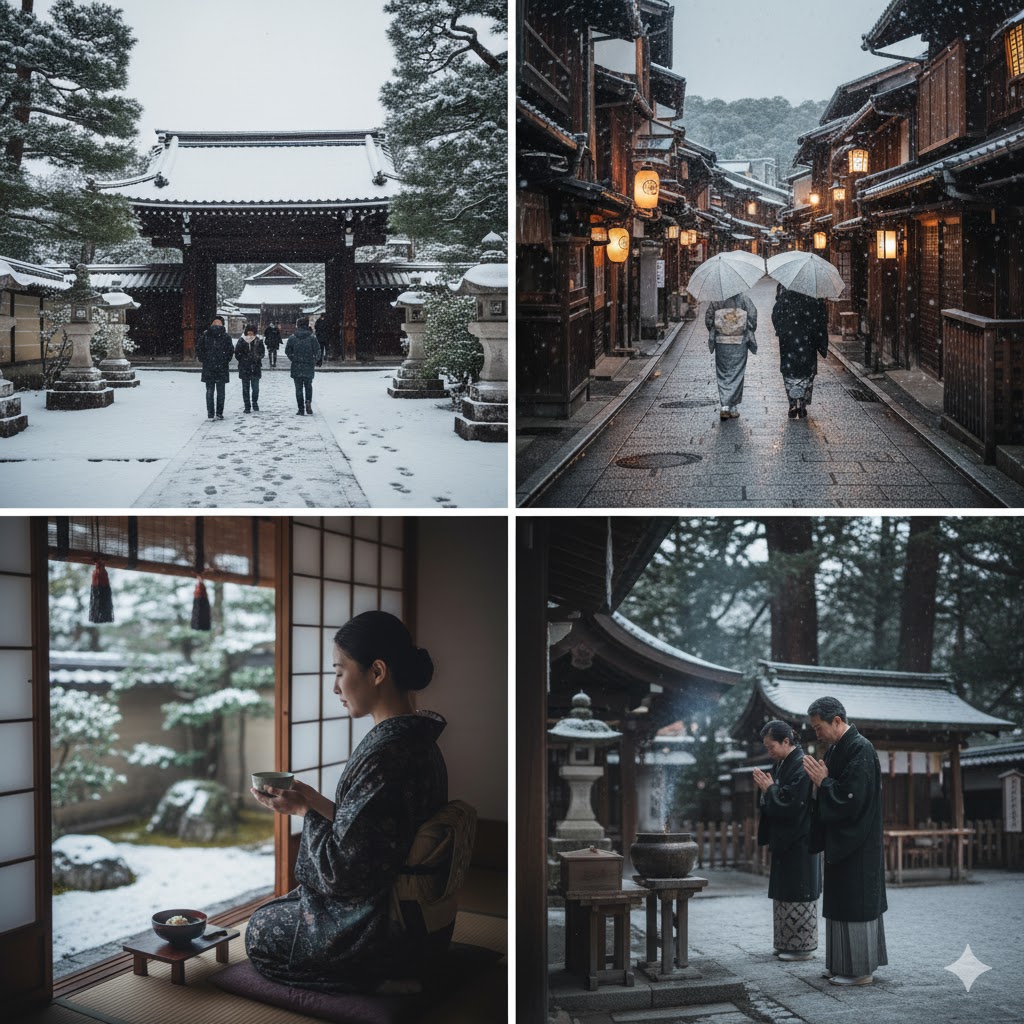
1. Introduction: The Secret of Winter Kyoto Awakens
Most people think of Kyoto and envision cherry blossoms in spring or brilliant autumn leaves dancing through temples. But let me share something that locals whisper about—something that changes everything about how you experience Japan’s ancient capital: January is when Kyoto truly reveals its authentic soul.
Imagine this: you’re walking through Higashiyama Ward on a crisp January morning. Your breath creates small clouds in the cold air. Frost glistens on traditional wooden buildings. Temple bells ring in the distance, their sound carrying clearly through the quiet streets—no crowds drowning out the sacred acoustics. This is Kyoto as it was meant to be experienced, not as Instagram hashtags and guided tour buses have taught millions of tourists to expect it.
Why does January matter so much? Simple mathematics, really. While spring’s cherry blossom season brings approximately two million international visitors to Kyoto in just a few weeks, January sees fewer than five hundred thousand visitors across the entire month. That’s not just fewer people; that’s a completely different experience of the same physical spaces.
But here’s the beautiful part that most travel guides miss: after spending hours exploring temples, walking historic streets, and genuinely absorbing centuries of cultural heritage, you’ll want to pause and refuel. Not with convenience food, but with something authentically local that actually completes your experience. That’s where the simple wisdom of udon comes in—comfort food elevated to cultural practice, a bowl of noodles that somehow contains the essence of Japanese philosophy.
In this comprehensive guide, we’re diving deep into why January is Kyoto’s best-kept secret, exploring the extraordinary attractions surrounding Masuyacho in Higashiyama Ward, understanding what makes this season spiritually significant, and explaining why taking time for a carefully crafted udon meal isn’t just feeding your body—it’s feeding your understanding of Japanese culture itself.
Ready to discover Kyoto the way it deserves to be experienced? Let’s go.
2. Understanding January: Why Winter Transforms Kyoto Completely
2-1. The Climate: More Than Just Cold
January in Kyoto operates according to its own rules, creating an entirely different sensory experience than other seasons. Temperatures typically range between 35 and 50 degrees Fahrenheit (2 to 10 degrees Celsius). This is cold enough to feel genuinely chilly—you’ll want layers—but not so cold that outdoor activity becomes unpleasant.
Snow in Kyoto is somewhat rare, occurring maybe three to five times annually in measurable amounts. When it does fall, the visual transformation is genuinely stunning. The crystalline white flakes settle on centuries-old temple roofs, shrine gates, traditional machiya buildings, and bamboo groves. The effect is almost ethereal: structures that have weathered over a thousand years suddenly appear soft, almost dreamlike, as if you’re viewing them through a filter that reveals their spiritual essence.
But here’s what matters even more than the occasional snow: the light. January offers the clearest atmospheric conditions of any Kyoto season. The low-angle winter sun creates dramatic shadows that emphasize architectural details, illuminate interior spaces that remain shadowed in summer, and bathes everything in a crystalline quality that photographers dream about. Early morning light (around 7:00 to 8:30 AM) creates long shadows that make temple structures appear almost three-dimensional. Late afternoon light (around 4:00 to 4:30 PM) turns everything golden, making even ordinary streets feel sacred.
2-2. The Psychological Impact: Quietness as Sacred Space
This might sound poetic, but it’s actually neurologically real: quietness affects brain function. When you’re walking through Higashiyama in January, your nervous system is processing entirely different stimuli than it would in crowded seasons. Fewer people means reduced auditory input, which means your brain isn’t constantly processing competing voices, laughter, and mechanical camera sounds. Fewer people also means more personal space, which reduces the subconscious stress of navigating crowds.
In this calmer state, your capacity for genuine observation dramatically increases. You’re not in survival mode; you’re in receptive mode. You can actually listen to the sound of water in a temple garden. You can notice the grain patterns in wooden beams. You can read the historical information posted at each site rather than simply rushing through. You can have eye contact and actual conversation with shopkeepers rather than being processed through a commercial transaction.
This matters specifically because temples and shrines in Kyoto weren’t built for mass tourism. They were built for spiritual practice. The spatial arrangements, the materials, the light they receive—all of this was designed for people moving slowly, thinking deeply, and opening themselves to something beyond the everyday. January returns these spaces to their original purpose. You’re not just touring; you’re inhabiting spaces designed for contemplation.
2-3. Spiritual Significance: Why Winter Matters in Japanese Tradition
In both Buddhist and Shinto traditions—the two spiritual frameworks that shaped Kyoto’s architecture and culture—winter holds profound significance that has nothing to do with tourism marketing. The quietness of winter, the reduced sunlight, the cold air, the sparse vegetation—these aren’t obstacles to understanding but rather essential elements that reveal deeper meaning.
Buddhist philosophy teaches about impermanence (anicca in Sanskrit). Winter visibly demonstrates this principle. Trees that were lush in summer stand bare. Flowers are gone. The world appears emptier, simpler, more honest about the transient nature of all things. Walking through this landscape invokes philosophical understanding at a visceral level—you’re not learning about impermanence intellectually; you’re experiencing it directly.
Similarly, many Shinto and Buddhist practices specifically involve winter meditation and purification. January includes New Year shrine visits (January 1st through 3rd sees special ceremonies), mid-winter meditation retreats, and cleansing rituals. If you’re present during these times, you’re witnessing genuine spiritual practice rather than performance tourism.
Many of Kyoto’s most significant temples also maintain their original purposes in January. You might encounter monks actually practicing, worshippers actually praying, or pilgrim groups actually undertaking spiritual retreats. This authenticity—seeing these spaces used for their actual purpose rather than purely as tourist attractions—changes everything about how you understand Japan.
3. Higashiyama Ward: Where Kyoto’s Soul Concentrates
Higashiyama Ward (Higashiyama-ku) is where approximately 30 percent of Kyoto’s significant historical and cultural sites cluster. This wasn’t random development; geography shaped this concentration over more than twelve centuries. The area sits at the foot of forested mountains where temples found spiritual significance, and between major thoroughfares where pilgrims naturally traveled. Over time, layer after layer of cultural construction accumulated, creating what essentially amounts to an open-air museum of Japanese civilization.
But unlike museums, Higashiyama is alive. Temples still function as places of worship. Shops still operate as they have for generations. Monks still practice meditation in centuries-old buildings. This living quality fundamentally changes your experience.
3-1. Kiyomizu-dera: The Temple That Defines Kyoto’s Image
Let’s start with the most iconic. Kiyomizu-dera (清水寺), literally translating to “Temple of Pure Water,” was established in 798 CE by a Buddhist monk named Enchin who discovered a naturally pure spring in these mountains. This makes Kiyomizu-dera over 1,200 years old—predating most of what the Western world considers “old.”
The temple’s main structure—the Kiyomizu Hall—sits dramatically on a wooden platform that extends out over a cliff. This architectural audacity is remarkable when you consider it was built without modern engineering. The structure cantilevers approximately forty-two feet out from the cliff face, supported by massive wooden beams driven into the hillside. Japanese carpenters achieved this without nails, using only carefully calculated joinery. The platform offers panoramic views of Kyoto spreading out below—a perspective that has awed visitors for more than a thousand years.
The temple’s name derives from the Otowa Waterfall (Otowa no taki) that flows beneath the main hall. For centuries, the tradition involves drinking from this water, with three distinct streams said to confer different blessings: longevity, academic success, and romantic love. (If you’re interested in matters of the heart, there’s supposedly significant competitive pressure to access that particular stream!)
Why January is ideal here: The morning mist creates an almost supernatural atmosphere. The falling water becomes clearly audible without crowd noise masking it. You have time to actually sit on the viewing platform and contemplate the landscape rather than positioning yourself for a quick photograph before the crowds push you forward. Early morning arrival (the temple opens at 6:00 AM) is genuinely transformative.
Practical details: Entrance fee is ¥400 (approximately $3 USD). Allow 45 minutes to one hour. Bring sturdy, waterproof shoes—the wooden platforms become slippery in winter.
3-2. Jisho-ji: The Silver Pavilion’s Philosophy of Restraint
While Kinkaku-ji (the Golden Pavilion) dominates global imagination about Kyoto temples, many discerning visitors prefer Jisho-ji (慈照寺), formally known as the Silver Pavilion or Ginkaku-ji. This preference reflects deeper understanding of Japanese aesthetics.
Built in 1482 by the shogun Ashikaga Yoshimasa as a retirement temple, Jisho-ji embodies philosophical principles fundamentally different from gold-adorned temples. Where Kinkaku-ji expresses transcendence through material wealth and visual splendor, Jisho-ji expresses spiritual depth through simplicity, emptiness, and finding profound beauty in restraint.
The pavilion itself isn’t actually silver-covered (the name reflects historical intention rather than reality). Instead, the simple wooden structure demonstrates how proportional relationships, material quality, and spatial awareness create beauty without ornamentation. The two-story building, covered in black-stained wooden shingles, presents almost austere elegance. This is not the beauty of accumulation but the beauty of essential form.
The surrounding gardens, designed by the legendary landscape architect Soami, rank among Japan’s most important and most carefully preserved garden designs. The approach involves deliberate pacing through various spaces: narrow gate, small initial garden, then the major viewing garden with its carefully raked gravel (representing water), moss-covered stones (representing mountains), and strategically positioned trees. The composition invites meditation on the relationship between emptiness and form, between what is shown and what is suggested.
Why January reveals what other seasons hide: During spring and summer, flowering trees and full foliage partially obscure the underlying garden design. Winter removes this obscuring layer. The bare branches, the clear sight lines, the unobstructed views—all of this reveals the geometry and philosophy that the garden designer deliberately constructed. You see what the artist intended.
Visitor information: Entrance fee is ¥500 (approximately $4 USD). Unlike many temples, Jisho-ji restricts photography—which actually enhances the meditative experience. Most visitors spend at least 60–90 minutes here simply observing.
3-3. Kodai-ji: A Widow’s Temple and Women’s History
Founded in 1606, Kodai-ji tells a fascinating human story that tourist literature often glosses over. The temple was established by Yodo-dono, the widow of the great feudal lord Toyotomi Hideyoshi. After Hideyoshi’s death and the subsequent fall of Toyotomi forces to rival Tokugawa power, Yodo-dono retreated to monastic life, building this temple as both memorial and personal sanctuary.
This historical narrative—a powerful woman navigating loss, political defeat, and spiritual transformation—resonates on a human level that transcends tourism. The buildings themselves reflect this story. The main hall (Amidado) features elaborate decoration, unusual for Zen Buddhist aesthetics, reflecting the temple founder’s personal wealth and connection to power. Yet the surrounding gardens express more austere philosophical principles, suggesting spiritual growth and acceptance of impermanence.
The temple complex includes several remarkable structures: beautiful gardens featuring both dry stone arrangements and water features, intricate wooden architecture showcasing different artistic traditions, and sacred halls. Kodai-ji also maintains an active art collection that changes seasonally, featuring paintings, sculptures, and decorative arts from various periods.
Essential experiences here: Sit in one of the viewing platforms overlooking the gardens. Read the historical information—it adds genuine depth. Observe how the architecture and garden design express contradictions between power and renunciation, decoration and simplicity.
Practical details: Entrance fee is ¥600 (approximately $4.50 USD). Plan for 45-60 minutes minimum.
3-4. Yasaka Shrine: Kyoto’s Protective Guardian
Also known as Gion Shrine (Gion-sha), Yasaka Shrine is one of Kyoto’s most spiritually significant sites and one of its oldest. Founded in 656 CE (nearly 150 years before Kiyomizu-dera), this Shinto shrine has served as spiritual protector of Kyoto for over 1,350 years. The shrine is particularly known for the Gion Matsuri festival held every July—one of Japan’s most important and most elaborate summer celebrations attracting hundreds of thousands of visitors.
But Yasaka Shrine’s winter presence is equally powerful in different ways. The main building features exceptional wooden craftsmanship, intricate carving, and interior artwork depicting various deities and historical scenes. The shrine grounds contain small gardens offering peaceful meditation spaces. In January, with minimal crowds, you can actually observe these details rather than simply passing through.
What’s particularly interesting about Yasaka Shrine is that it remains genuinely active for local religious practice. You’ll encounter Kyoto residents coming to pray, perform purification rituals, and make wishes—not as performance for tourists but as actual spiritual practice. Observing this gives you insight into contemporary Japanese religious life that most tourism never reaches.
Why January is special here: Fewer tourists mean you can linger in various shrine spaces without feeling rushed. Staff have time for friendly conversation. You might witness actual religious practices rather than tourist activities.
Practical details: Entrance is free. Many visitors spend 30–45 minutes exploring the main buildings and surrounding grounds.
3-5. Hokanji and the Five-Story Pagoda
Located near Kiyomizu-dera, Hokanji Temple (法観寺) houses one of Kyoto’s most photographed structures: a distinctive five-story pagoda visible from multiple vantage points throughout the Higashiyama District. The pagoda’s graceful proportions and traditional design make it an icon of Kyoto’s architectural heritage—it’s probably in hundreds of your mental images of Japan even if you don’t remember the specific name.
The pagoda itself dates to the 17th century (though it’s built on foundations from the 9th century). Its architectural style represents the height of traditional wooden pagoda design—each story seems to float independently, connected by an elegant central column. The design isn’t arbitrary; it reflects both aesthetic principles and structural engineering designed to allow flexibility during earthquakes.
The temple complex surrounding the pagoda deserves exploration beyond simply photographing the external structure. The main temple building, founded in 1407, contains beautiful gardens and architectural details worth examining. January’s quiet atmosphere lets you actually experience these spaces rather than collecting exterior photographs.
Practical details: The pagoda grounds are publicly viewable. The temple building itself charges an entrance fee of ¥600 (approximately $4.50 USD). Most visitors spend 30–40 minutes here.
4. Historic Streets: Walking Through Living Heritage
The streets connecting Higashiyama’s major temples form an intricate network of preserved cultural heritage. Walking these paths is literal time travel—you’re moving through the same urban fabric that pilgrims navigated over a thousand years ago, though the purposes and commerce have evolved.
4-1. Ninenzaka and Sannenzaka: Where History Meets Contemporary Commerce
Ninenzaka (二年坂, literally “Two-Year Slope”) and Sannenzaka (三年坂, literally “Three-Year Slope”) are adjacent sloped streets connecting Kiyomizu-dera temple to the surrounding neighborhoods. The names supposedly reference a folk legend: tripping on Ninenzaka brings bad luck lasting two years; tripping on Sannenzaka lasts three years. Perhaps this explains why visitors tread carefully on these charming streets!
These streets feature remarkably preserved traditional machiya (町屋) architecture—the classical Kyoto townhouse design characterized by narrow wooden facades, sliding lattice windows (lattices called “kumiko”), and interior courtyard designs. The architecture served multiple purposes: the front rooms served as shops or workshops, while deeper interior spaces housed residential areas. This ground-floor commerce with residential space above became the template for traditional Japanese urban design.
Over centuries, these buildings have served as residences, shops, temples, teahouses, and restaurants. Many maintain this mixed-use character today. Walking Ninenzaka and Sannenzaka offers genuine insight into how Kyoto traditionally functioned—not as separate zones for tourists and residents, but as integrated spaces where commerce, residence, spirituality, and daily life all intermixed.
January’s advantages become obvious immediately. The bare branches of seasonal decorations create intricate patterns against pale winter sky. The clear winter light emphasizes the craftsmanship of wooden facades and lattice work, revealing joinery and weathering that summer foliage hides. Most significantly, with fewer tourists, you can actually enter shops and cafes, browse without rushing, and have genuine conversations with shopkeepers who suddenly have time for visitors.
The shops themselves merit exploration. Traditional artisans maintain practices that have existed for generations: washi paper (handmade Japanese paper) artists demonstrate their techniques, wooden fan craftspeople work in visible studios, ceramic specialists curate carefully selected pieces, and sweet-makers offer handmade confections prepared according to century-old recipes. Many shops have operated in the same location for generations, giving you direct insight into Kyoto’s artisanal traditions.
Recommendation for January visitors: Arrive with no agenda beyond wandering. Skip the obviously touristy shops and stop at small galleries, modest cafes, and family-run establishments. This unhurried exploration is the actual content of your January visit—more valuable than any structured itinerary.
4-2. Nene-no-Michi: The Philosopher’s Path and Urban Water Philosophy
Nene-no-Michi (寧々の道, translated as “Path of Nene” after a feudal lord’s wife, or more poetically as “Philosopher’s Path”) represents something profound about Kyoto’s design philosophy. This stone-paved walkway runs alongside a peaceful canal for approximately 2 kilometers (1.2 miles), connecting different districts while allowing contemplation and movement through natural space within an urban environment.
The canal, part of Kyoto’s sophisticated water management system, reflects an important cultural principle: rather than hiding infrastructure underground, Kyoto celebrates it as integrated aesthetic and functional space. The canal flows visibly through the city, serving practical purposes (water for gardens, power for mills, fire suppression) while simultaneously providing aesthetic pleasure and spiritual significance. In Japanese philosophy, flowing water symbolizes impermanence, renewal, and life force.
During cherry blossom season, this path becomes so crowded that peaceful walking becomes nearly impossible. In January, it returns to its original purpose: a quiet route through the landscape, connecting different areas of Higashiyama while inviting contemplation. The bare winter trees line the path differently than summer—you have clearer sight lines to surrounding neighborhoods, and the bare branches create intricate patterns.
The canal itself undergoes interesting transformations in January. Sometimes ice forms at the edges—not thick enough to walk on, but creating crystalline patterns that catch light beautifully. The flowing water remains audible without crowd noise masking it. Many visitors stand for extended periods simply observing how light plays across moving water.
Many small cafes, galleries, and restaurants line this path. January’s quiet atmosphere makes these establishments particularly welcoming. You might push open a small wooden door and find yourself in a charming tea shop overlooking the canal. This becomes a different kind of cultural experience than structured tourism—accidental, organic, genuinely connected to how locals experience these spaces.
Pro tip: Walk the path in early morning or late afternoon. The light during these times transforms the canal into something almost dreamlike.
5. Creating Your Perfect January Higashiyama Itinerary
Rather than rushing through attractions, January rewards a slower, more contemplative approach. Here’s a suggested rhythm:
Early Morning (6:00-8:30 AM): Arrive at Kiyomizu-dera as it opens. Experience the misty, quiet temple grounds. Most mornings in January, you’ll have the platform to yourself. Spend time observing views, sitting in peaceful spaces, absorbing the atmosphere. This isn’t wasting time; this is the core experience.
Late Morning (8:30-11:00 AM): Walk slowly through Ninenzaka and Sannenzaka. Don’t rush. Stop at small galleries. Chat with shopkeepers who have actual time to talk with you. Have tea at a traditional cafe. Stop at sweet shops and try local specialties. This unhurried wandering is more valuable than visiting multiple major sites quickly.
Midday (11:00 AM-1:00 PM): Continue exploring temples like Kodai-ji or walk toward Nene-no-Michi. This period offers excellent light for photography or simple observation. If energy permits, visit additional temples.
Lunchtime (1:00-2:00 PM): This is your perfect moment for udon at Kyoto Udon Kaisha or another local restaurant. (See section below.)
Afternoon (2:00-5:00 PM): Visit Yasaka Shrine. Explore gardens and architectural details. Walk Nene-no-Michi. If energy remains, visit Jisho-ji if you haven’t already. Pace yourself—by this time in January, fatigue accumulates quickly.
Evening (5:00-6:00 PM): As light fades, observe how the same buildings transform in sunset light. This final hour offers sublime photographic conditions and a contemplative way to end your day.
This itinerary assumes a full day in Higashiyama. You could easily extend it across two days, slowing even further and allowing yourself to sit quietly in various spaces, or exploring neighborhoods between major temples.
6. Udon: The Cuisine That Completes the Cultural Experience
6-1. Why Udon Isn’t Just Lunch—It’s Cultural Practice
This might sound like overstatement, but it reflects how Japanese culture approaches eating. In Japan, food isn’t primarily fuel (although it serves that purpose). Food is philosophy made edible. It’s spiritual practice. It’s art. It’s history. Most importantly, it’s the way locals actually live—whereas temples are historical artifacts, eating is how people actually experience their culture daily.
Udon specifically embodies principles central to both Zen Buddhist aesthetics and Japanese artistic tradition generally: simplicity, impermanence, seasonality, and respect for ingredients. A perfect bowl of udon expresses these concepts through taste, texture, aroma, and the ritual of preparation and consumption.
In January, after spending hours moving through cold temples and streets, a steaming bowl of udon serves multiple functions simultaneously. It provides physical warmth—the steam rises into your face, and the hot broth warms your core from within. It provides nourishment—carbohydrates and minerals from the broth and toppings. Most importantly, it forces a meditative meal after active sightseeing. You can’t hurry through udon; the temperature demands slowness, and the portion size encourages mindful eating.
6-2. The Simplicity That Requires Mastery
Great udon is deceptively simple. A perfect bowl contains only a few components: noodles, broth, and perhaps a simple topping or two. This simplicity means that each element must be exceptional. There’s nowhere to hide poor quality or cutting corners.
The noodles: Udon noodles are thicker and chewier than ramen (which are curly) or soba (which are made from buckwheat). The texture comes from using specific wheat varieties and carefully balancing water-to-flour ratios. Quality udon noodles have subtle sweetness, tender texture but with enough resistance to require actual chewing. The best noodles have what Japanese cooks call “koshi”—a springy resistance that bounces back slightly when bitten. Poor udon becomes mushy; great udon is textural revelation.
The broth: This is where the actual magic occurs. Master udon chefs develop broths that simmer for 12 to 48 hours, sometimes longer. The broth typically begins with kombu (dried kelp), added cold and brought slowly to temperature to extract umami compounds without bitterness. Bonito flakes (katsuobushi) add depth. Shiitake mushrooms, dried shrimp, dried sardines, and other ingredients layer their individual flavors into something complex yet somehow appearing simple. The best broths achieve what Japanese call “umami”—that fifth taste sensation beyond sweet, salty, sour, and bitter—that makes you want to keep eating and drinking. You can taste the dedication in every spoonful, sometimes literally—some broths reveal new flavor notes with each sip.
The toppings: January udon features seasonal additions that mark the time. You might find tender chicken simmered until it’s almost dissolving into the broth—the collagen becomes gelatin that enriches the broth. Seasonal vegetables (nankin/Japanese pumpkin, daikon radish, burdock root) appear in thoughtful preparations. A perfectly cooked egg with creamy yolk adds richness. Sometimes the most profound udon is topped only with sliced green onion and a dusting of seven-spice powder (shichimi togarashi). In Japanese aesthetics, restraint is its own form of expression.
6-3. The Ritual: How to Eat Udon Like You Understand Something Essential
Eating udon in a traditional restaurant involves practices that might seem strange if you’re unfamiliar with Japanese dining culture. Let’s demystify them so you can participate fully:
Slurping is correct behavior: Yes, you’re absolutely supposed to slurp. In Japan, slurping isn’t impolite; it’s actually encouraged and signals appreciation. Slurping serves multiple functions: it cools the noodles as they enter your mouth (traditional udon is served very hot), it aerates the noodles and broth together (which enhances flavor perception), and it demonstrates appreciation to the restaurant staff. Eat confidently; slurping is correct behavior. Listen to other diners—the sound of satisfied slurping is part of the authentic udon restaurant experience.
Bowl orientation and positioning: Udon is served in large ceramic bowls designed to retain heat. It’s perfectly normal and expected to hold the bowl near your mouth as you eat—the rising steam naturally warms your face, which is pleasant in January. Use the provided spoon to gather broth, or simply bring the bowl toward your face and drink. Either approach is acceptable.
Finishing the broth: After eating the noodles, it’s perfectly acceptable and actually encouraged to drink the remaining broth directly from the bowl. This isn’t considered rude; it’s considered appreciative. You’re acknowledging the skill and effort that went into creating that broth. A slight slurping sound is acceptable and even desirable.
Tea as palate interlude: Many udon restaurants provide hot tea (usually free) as a palate cleanser between bites. This pause—this moment of sipping tea while looking out a window or simply sitting—is part of the meal’s intended rhythm. Don’t rush past it. This breathing space is actually part of the experience.
The conversation of eating: In traditional udon shops, people tend to eat relatively quietly. This isn’t coldness or antisocial behavior; it’s respect for the meal and the skill behind it. The meal itself is the conversation—between you, your food, and the chef who created it.
7. Kyoto Udon Kaisha: Your Strategic Rest Point
Located at Masuyacho in Higashiyama Ward, Kyoto Udon Kaisha sits at the exact geographic intersection of Kyoto’s most important historical sites. This location carries centuries of significance—it’s a natural gathering point where human geography and spiritual significance align.
7-1. Why This Location Matters Historically
From Masuyacho, major attractions are within easy walking distance:
Kiyomizu-dera: 10-minute walk downhill through historic streets
Yasaka Shrine: 5-minute walk, easily reachable on foot
Nene-no-Michi (Philosopher’s Path): 3-minute walk, providing peaceful approach through nature
Ninenzaka and Sannenzaka: 2-minute walk, the heart of historical commerce and traditional architecture
Kodai-ji Temple: 8-minute walk through quiet neighborhoods
Hokanji Five-Story Pagoda: 7-minute walk, visible as landmark orientation point
This geographical centrality isn’t accidental; it reflects centuries of urban development. For over a thousand years, pilgrims and travelers naturally clustered near these routes. Commerce developed to serve them. Temples established themselves at spiritually significant locations. Over time, layers of cultural accumulation created exactly what you’re experiencing today.
The restaurant becomes a natural pause point—not an afterthought, but an essential integration into your exploration.
7-2. What Kyoto Udon Kaisha Offers
The restaurant embodies Kyoto’s sophisticated approach to culinary tradition: deeply respectful of historical practices, committed to genuine quality, but simultaneously welcoming to contemporary visitors. The casual atmosphere (you might sit at a counter or at small tables) means you’re dining alongside locals, not separated in a tourist-only zone. This mixing of travelers and residents is how authentic cultural spaces function.
The menu changes seasonally, with particular emphasis on what local suppliers provide in January. Winter udon typically features:
Soft egg udon: A perfectly poached egg with creamy yolk adding richness to the broth, the yolk becoming emulsified throughout your bowl
Chicken and vegetable udon: Tender chicken simmered until nearly melting, with seasonal vegetables providing textural contrast and nutritional balance
Simple topping udon: Sometimes the most profound meal is the simplest—excellent noodles, excellent broth, fresh green onion, perhaps a touch of raw ginger for brightness
Vegetable-forward preparations: Reflecting Buddhist temple cuisine (shojin ryori) traditions, udon featuring seasonal vegetables and tofu preparations, demonstrating how restraint expresses sophistication
7-3. The Sensory Experience: What to Expect
Imagine this sequence: You push open the restaurant door (likely a traditional wooden door with noren curtain), and warm air embracing the distinctive aroma of simmering broth greets you immediately. The contrast between outdoor January cold and interior warmth is almost shocking—in the best possible way.
You remove your shoes if requested (some udon shops require this, others don’t). You sit at the counter or a small table. A staff member brings a menu and hot tea. You order udon, and through the service window, you watch skilled staff manipulate noodles in boiling water with practiced precision. They’ve done this thousands of times—their movements are efficient poetry.
Within minutes, a steaming bowl arrives. You observe its beauty for a moment. You lift chopsticks and spoon. You take the first noodles, slurping the first noodles along with hot broth. The warmth moves through you. The flavors—both simple and complex—register with complete attention because you’ve deliberately slowed down. This meal, this moment, completes the January Kyoto experience. You’re not just observing Japan from the outside; you’re participating in it directly.
8. Practical Information for January Kyoto Success
8-1. Weather Preparation: Clothing and Packing Strategy
January in Kyoto demands respectful preparation:
Layering system: Bring multiple layers you can add or remove as conditions change. Typically: a base layer (thermal underwear or regular long underwear), a middle layer (sweater, fleece, or wool), and an outer layer (waterproof coat). This flexibility allows adjustment as temperature changes throughout the day.
Footwear is genuinely critical: Temple grounds, historic streets, and canal paths can all become slippery in winter. Waterproof hiking boots or sturdy waterproof walking shoes are genuinely important safety considerations. Cheap canvas shoes will leave your feet cold and wet within 20 minutes. Bring wool socks—thick, quality socks make enormous difference in January comfort. Consider bringing two pairs and rotating them, or even three pairs if you’re hiking extensively.
Accessories matter more than aesthetics: Gloves and a winter hat aren’t just comfort; they’re genuine necessity. A scarf serves dual purposes—warmth and sun protection. January’s clear light, reflecting off pale temple stone, can actually sunburn your face.
Backup rain preparation: Carry a compact umbrella. While January snow is occasional, winter rain is more common. Light rain actually enhances the contemplative atmosphere, but being prepared means you’re more relaxed about it.
8-2. Energy and Hydration Management
Moving through temples and streets for extended hours requires attention to hydration and fuel:
Water remains essential: Carry a refillable water bottle. While vending machines exist throughout Higashiyama, some locations don’t have them. Staying hydrated aids temperature regulation, mental clarity, and overall wellbeing during physical activity in cold weather.
Strategic snacking: Traditional sweet shops along Ninenzaka and Sannenzaka offer mochi (rice cakes), manju (sweet bean paste-filled pastries), and other treats providing quick energy. Small cafes offer tea and simple meals. Plan your main meal strategically; lunchtime (11:30 AM–1:00 PM) brings crowding even in January, while arriving just before 11:00 AM or after 1:30 PM offers better experiences.
Energy distribution: January fatigue accumulates quickly in cold weather. Consider breaking exploration into morning and afternoon sessions, with udon serving as your reset point between them. This isn’t laziness; this is intelligent pacing that allows you to be more fully present in both morning and afternoon.
8-3. Temple Etiquette and Respect Practices
Respect for these active sacred spaces matters:
Photography restrictions: Many temples prohibit photography in certain areas, particularly interiors. Always look for prohibition signs; when in doubt, ask. Some temples restrict photography of specific artworks or architectural elements.
Noise consideration: Temple grounds are spaces for prayer and meditation. Speak softly, avoid group conversations, and be particularly quiet in buildings where worship might be occurring. This isn’t about rigid rules but acknowledging that these spaces matter spiritually to practitioners.
Clothing appropriateness: Wear respectful attire. Avoid sleeveless clothing, very short shorts or skirts, and overly casual or revealing garments. January’s cold weather naturally encourages layering and appropriate coverage, but remember that these are working religious spaces, not photography backdrops.
Timing considerations: Arrive early to experience less-crowded conditions and better light. By 2:00 PM in January, daylight begins declining noticeably. By 4:30 PM, natural light essentially ends. Plan accordingly.
8-4. Budget Calculations
Most significant Higashiyama temples charge entrance fees:
Individual temple entries: ¥400–800 (approximately $3–6 USD each)
Day visiting 4–5 major temples: Approximately ¥2,000–3,000 total ($15–22 USD)
Meal at Kyoto Udon Kaisha: Approximately ¥800–1,200 ($6–9 USD)
Snacks and tea: ¥500–1,000 ($4–8 USD)
Day total for cultural exploration and food: Approximately ¥3,500–5,000 ($26–37 USD)
Japan remains affordable for cultural tourism if you eat at local restaurants and avoid hotel tourist restaurants.
9. Why January Kyoto Transforms Understanding: The Deeper Significance
Tourism professionals often frame travel as “sightseeing”—collecting attractions, accumulating experiences, filling memory cards with photographs. This framework treats travel as consumption of spectacular moments.
January Kyoto invites a fundamentally different model: deep cultural immersion through sustained presence and genuine attention. The temples themselves don’t change between seasons. Kiyomizu-dera in July and Kiyomizu-dera in January house the same architecture, serve the same spiritual purpose, carry the same historical significance. What changes is your capacity to be genuinely present with these spaces.
January’s quiet atmosphere, the reduced human volume, the clear light, and the contemplative mood that winter evokes combine to create different neurological states than summer’s sensory overload. You’re not stressed about finding personal space or desperate to position yourself for that perfect photograph. Your nervous system is relatively calm, allowing genuine observation and reflection.
This matters specifically because Japan’s cultural heritage isn’t primarily visual. Yes, temples are architecturally beautiful. Yes, gardens are aesthetically sophisticated. But their actual purpose involves spiritual practice, philosophical inquiry, and the cultivation of particular mental states. Rushing through a temple in 20 minutes with hundreds of other people—all jostling for photographs—lets you appreciate visual aspects but fundamentally misses the actual content.
January creates opportunity for something deeper. When you sit quietly in a temple garden for 30 minutes, observing how light moves across stone, how wind affects water surface, how the space itself seems to hold quietness—that’s when you begin understanding why these places were built. That’s when Buddhist and Shinto philosophical concepts transition from intellectual information to direct experience.
Similarly, eating udon mindfully, slowing to observe its preparation, acknowledging the hours of work that created the broth you’re drinking—that’s when food stops being fuel and becomes cultural participation. You’re not consuming Japan; you’re participating in it.
10. Conclusion: Claim Your Authentic January Kyoto Story
Kyoto in January is a gift offered to travelers willing to accept it. It demands minor inconveniences—the cold, the need for early starts, the lack of convenient crowds—but rewards with something that comfort-seeking mass tourism cannot provide: genuine access to centuries-old cultural spaces and practices experienced with authentic presence.
The Higashiyama District, with its concentration of world-class temples, preserved historic streets, and living cultural traditions, becomes something almost private when visited in winter. You’ll experience spaces that millions visit annually, but you’ll experience them differently—more slowly, more deeply, more meaningfully.
Taking time to sit quietly in a temple garden. Slurping udon broth that required someone 36 hours to prepare. Observing how winter light transforms familiar streets into sacred spaces. Listening to temple bells without competing noise. Having genuine conversations with shopkeepers who have actual time for you. These moments cost nothing extra but add something essential to your experience.
January Kyoto doesn’t attract crowds because most travelers follow established patterns. They assume that obvious seasons (cherry blossoms, autumn leaves) are best seasons. But those who venture into winter discover something that marketing materials cannot quite capture: a city at peace with itself, offering genuine encounters with its own heritage, requesting only that you slow down enough to appreciate what’s being offered.
Bundle up. Arrive early. Explore thoroughly but unhurried. Sit in temples longer than feels necessary. Eat udon with attention and presence. Take notes or photographs or neither. Most importantly, be genuinely present for the experience rather than collecting it for Instagram or distant memory.
The temples will still be standing next year, next decade, next century. But your January Kyoto experience? That’s entirely unique to you, unrepeatable, genuinely personal. Don’t miss it.
Welcome to authentic Kyoto. We’ve been waiting for you.
11. Essential Statistics for Context:
Kyoto receives approximately 8 million international tourists annually
Approximately 2 million visit during cherry blossom season (March-April)
January sees fewer than 500,000 international visitors
Higashiyama Ward contains over 30 significant temples and shrines
Kiyomizu-dera receives over 2.5 million annual visitors (crowds dramatically reduced in January)
Average Kyoto meal cost: ¥1,000–1,500 ($7.50–11 USD)
Temple entrance fees: ¥400–800 ($3–6 USD)