
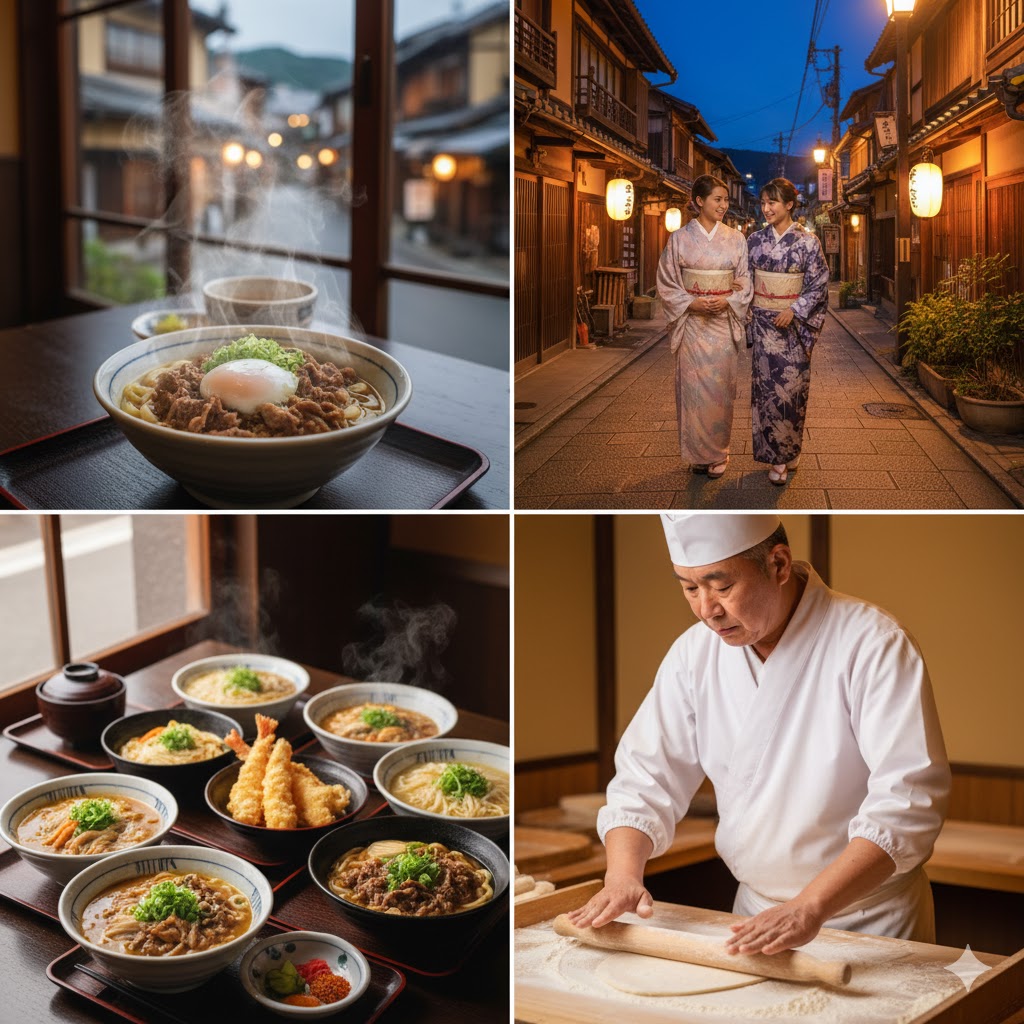
1. Introduction: Why Dinner in Higashiyama is a Must-Do Experience
Most travelers plan their Kyoto adventures around daytime activities. They explore temples at peak hours, navigate crowded shopping streets at midday, and rush through dinner before retiring to their hotels. But here’s what experienced Kyoto travelers understand: the city’s true magic emerges after sunset.
Higashiyama, the district that already captivates visitors during daylight, transforms completely as evening falls. Temple lights illuminate ancient architecture. Lanterns flicker along cobblestone streets. The crowds thin dramatically. And locals emerge, moving through the district with purpose and familiarity that daytime tourists miss entirely.
This is when dinner becomes not just sustenance, but an experience. This is when a meal at Kyo Udon Ishin becomes the perfect anchor to an unforgettable Kyoto evening.
Positioned at Masuyacho in the heart of Higashiyama, Kyo Udon Ishin offers something rare: authentic, deeply satisfying cuisine that complements rather than conflicts with the evening’s spiritual and atmospheric energy. After exploring Gion’s geisha district, walking through illuminated temple grounds, or strolling lantern-lit streets, settling into a bowl of expertly crafted udon represents the ideal transition between Kyoto’s external beauty and internal contemplation.
This guide explores how to design the perfect Kyoto evening—one that showcases the district’s nocturnal beauty while delivering a dinner experience worth remembering long after you leave Japan.
2. Why Evening in Higashiyama Beats Daytime Exploration
2-1. The Transformation: How Sunset Changes Everything
Daytime Higashiyama is undeniably beautiful. Temples gleam in sunlight. Cobblestone streets buzz with activity. Shop windows display their wares. But evening Higashiyama is something else entirely—a place where history feels palpable rather than historical.
The practical reason is simple: the crowds disappear. Most tour groups operate on schedule, departing temples by 4 PM to make evening buses. Casual tourists prioritize “checking boxes” on sightseeing lists during daylight. By 5 PM, Higashiyama’s major streets are noticeably quieter. By 6 PM, they feel genuinely peaceful. By 7 PM, you’ll experience the district the way locals do—without constant jostling for space or fighting through crowds to photograph temples.
But the transformation goes deeper than crowd reduction. Evening light is fundamentally different from daylight. Temple stonework, which appears grey and ordinary in midday sun, glows with warmth under evening light. The wooden gates and traditional architecture reveal details invisible during daylight—the grain of aged wood, the patina of ancient metal fixtures, the subtle construction techniques that centuries-old buildings employ.
The spiritual energy also shifts. Daytime temples accommodate tourists moving through quickly, snapping photographs, checking guidebooks. Evening temples host genuine worshippers, monks conducting ceremonies, and visitors who’ve come specifically for contemplation. The atmosphere changes from touristic to sacred. You feel it immediately upon entering—even as an outsider, you sense you’re stepping into something genuine rather than performed for visitors.
2-2. The Evening Economy: Less Crowded Attractions, Richer Experiences
Here’s an underappreciated reality about evening tourism in Kyoto: most paid attractions close by 5 PM, yet countless experiences remain available free or low-cost for evening visitors.
Temple grounds, particularly the open areas where you can walk and observe architecture, remain accessible. You won’t see the precious interior halls or carefully controlled main structures, but you’ll experience the temple grounds themselves—often the most beautiful and spiritual parts. Stone pathways, moss-covered grounds, ancient trees, bell towers, and landscaped gardens all remain visible without paying entrance fees.
The shopping streets operate differently at night. Daytime, stores bombard you with sales pitches and inventory abundance. Evening, most retail shops close, but restaurants and casual eateries open. This shift changes the character completely. You’re no longer navigating shopping crowds but rather walking through atmospheric streets where locals gather for dinner, drinks, and casual socializing.
Gion, the famous geisha district, transforms dramatically after sunset. Evening Gion reveals geisha preparing for evening appointments (particularly around 5-6 PM as they depart their offices), atmospheric tea houses and restaurants welcoming dinner guests, and the district’s true nighttime character. The atmospheric ambiance many daytime visitors search for actually materializes at night—lanterns glow, wooden machiya buildings reveal their architectural beauty, and the district feels genuinely from another era.
2-3. Practical Advantages of Evening Dining and Exploring
Beyond the aesthetic transformation, evening exploration offers genuine practical advantages. Evening temperatures are significantly cooler than daytime, especially in summer months. You’ll be more comfortable walking, less exhausted from heat exposure, and more able to genuinely enjoy exploration without urgently seeking air conditioning and rest.
Restaurants and eateries operate best at night. Unlike daytime establishments rushing through peak lunch service with limited attention, evening restaurants can offer more personalized attention. Staff isn’t overwhelmed. Chefs can focus on quality rather than quantity. Reservations (when necessary) tend to be less required for quality establishments. This creates better dining experiences overall.
Your entire body will be better served by evening versus daytime exploration. After spending the morning and afternoon exploring temples, gardens, and shopping streets, evening exploration means you’re moving through the district when your body has rested and refueled—making it more enjoyable and less exhausting. A proper dinner, taken leisurely, provides genuine restoration before retiring, improving sleep quality and tomorrow’s energy levels.
3. Your Evening in Higashiyama: The Essential Attractions After Sunset
3-1. Gion: Where Geisha Culture and Tradition Converge
Gion’s reputation precedes it. This historic geisha district is perhaps Japan’s most famous old quarter, and rightfully so. Walking down Hanami-koji Street (Gion’s main thoroughfare) at any hour delivers atmosphere, but evening is when Gion truly comes alive.
Daytime Gion can feel somewhat commercialized—filled with tourists in rental kimonos, shop owners aggressively marketing souvenirs, and visitors moving in confused clusters trying to spot geisha. Evening Gion is radically different. The casual tourists have largely departed. Rental kimono businesses wind down operations. The district becomes primarily about its original purpose: a place where people gather for fine dining, cultural engagement, and evening entertainment.
Between 5 and 6 PM specifically, you’ll witness something magical: geisha departing their offices (ochaya) for evening appointments. These are genuine geisha (not tourists in rental costumes), moving with purpose toward tea houses and restaurants where they’ve been summoned for evening service. They move quickly, focused, in the elaborate makeup and traditional dress that creates an immediately striking visual impression. This glimpse into actual Gion operations happens nightly and represents one of Kyoto’s most authentic evening experiences.
The architectural beauty also maximizes at dusk. Gion’s wooden machiya buildings, many dating back centuries, reveal their craftsmanship under soft evening light. The grain of aged wood becomes visible. Details of architectural elements emerge. Lanterns—traditional paper lanterns outside restaurants and tea houses—begin glowing, creating an atmosphere that no daytime lighting can replicate.
Walking through Gion toward dinner at Kyo Udon Ishin creates a narrative arc. You experience the geisha district’s evening magic, then transition into a more personal, contemplative dining experience. The energy shift from Gion’s bustling activity to Kyo Udon Ishin’s peaceful focus creates a satisfying progression.
Distance from Kyo Udon Ishin: About 15-20 minute walk through atmospheric streets
3-2. Nene-no-Michi After Dark: Kyoto’s Most Romantic Evening Walk
If Gion represents Kyoto’s theatrical evening energy, Nene-no-Michi represents its contemplative side. This canal-side path stretching approximately 2 kilometers through Higashiyama is already beautiful during daylight, but evening transforms it into something approaching poetry.
During the day, Nene-no-Michi accommodates tourists, photographers, and casual walkers. Evening Nene-no-Michi becomes a different experience entirely. Lanterns illuminate the path at intervals. The water reflects surrounding buildings and sky in subtle ways. Trees create natural arches overhead. The sounds of the district—daytime crowd murmur—fade to distant background, replaced by water sounds, footsteps, and occasional voices of other evening strollers.
The genius of evening Nene-no-Michi is its solitude without isolation. You’ll encounter other visitors—perhaps other tourists, certainly some locals—but distances between people expand dramatically. You can walk, pause, reflect, photograph, or simply experience without the constant awareness of crowd pressure that daytime creates.
Autumn evenings on Nene-no-Michi deserve specific mention. As temperatures cool and foliage begins changing color, evening walks become almost meditative. The path’s maple trees create natural canopies of color. Lantern light filtered through colored leaves creates effects no designer could intentionally create. Many experienced Kyoto visitors rank autumn evening walks through Nene-no-Michi among their most memorable life experiences—not because of action-packed activity, but because of quiet beauty and peaceful reflection.
The path’s restaurants and cafes operate evening service, providing stopping points if desired. However, many visitors prefer walking the entire route without stopping, allowing the journey itself to be the experience. By the time you’ve completed the walk and headed toward Kyo Udon Ishin, you’ll be in exactly the right headspace for a contemplative dinner—calm, present, and genuinely hungry.
Distance from Kyo Udon Ishin: About 10 minute walk; multiple entry/exit points mean flexible routing
3-3. Kodai-ji Temple: Evening Illumination and Spiritual Atmosphere
While many temples close paid entry by early evening, Kodai-ji Temple remains partially accessible for evening exploration. More importantly, the temple’s exterior grounds, gardens, and architecture remain visible and particularly beautiful under evening light.
Founded in 1606 by Toyotomi Hideyoshi’s widow, Kodai-ji represents the elegance and refinement that Japanese Buddhist architecture can achieve. The main structures showcase architectural sophistication that daytime viewing, crowded with other visitors, often fails to reveal. Evening visits, with dramatically fewer people, allow genuine observation and appreciation.
The garden elements—moss, stones, water features—reveal different character evening versus daytime. Moss appears luminous under certain evening light conditions. Stone arrangements cast different shadows. Water features catch light in unexpected ways. The cumulative effect is a space that feels renewed despite having visited potentially during daytime.
For travelers seeking spiritual connection rather than just photographic documentation, evening temple visits offer legitimate advantages. The contemplative atmosphere, absence of crowds, and genuinely spiritual purpose of the space become apparent in ways daytime tourism sometimes obscures.
Distance from Kyo Udon Ishin: About 12 minute walk
3-4. Yasaka Shrine: Evening Spirituality and Local Atmosphere
Yasaka Shrine (also called Gion Shrine), positioned at the southern edge of Maruyama Park, shifts dramatically from day to evening. Daytime Yasaka functions as a photogenic stop on sightseeing circuits. Evening Yasaka reveals its actual purpose: an active place of worship and community gathering.
In the evening, you’ll encounter local residents making evening prayers or stopping briefly during their commutes. The shrine’s spiritual energy feels genuine rather than performed. Lanterns glow softly. The main structures become silhouettes against the darkening sky. The shrine’s connection to the famous Gion Matsuri festival becomes more palpable—you sense this as an actual community sacred space, not a museum or photo location.
The shrine’s grounds are publicly accessible in evening hours. A brief visit—even 15-20 minutes—provides space for reflection and genuine engagement with Kyoto’s spiritual culture. The transition from Yasaka’s peaceful contemplation directly to Kyo Udon Ishin’s restorative dining completes a evening progression from external activity to internal nourishment.
Distance from Kyo Udon Ishin: About 8 minute walk
3-5. Higashihongan-ji Temple: The Atmospheric Giant
While the main Higashihongan-ji Temple complex may have restricted evening access, the temple’s exterior and surrounding grounds remain accessible. This massive temple—one of Japan’s most significant Buddhist structures—becomes particularly striking at dusk.
The sheer scale and architectural complexity of Higashihongan-ji reveals itself differently at evening. Stone pathways and landscaped grounds show architectural planning invisible in daytime views. The temple’s influence on the surrounding district becomes apparent—you notice how the neighborhood’s layout, streets, and even individual buildings organize themselves around the temple’s presence.
The spiritual weight of the location is substantial. Even for non-Buddhist visitors, the sense of centuries of prayer, worship, and spiritual practice accumulates almost physically. Evening visits, quieter and more introspective than daytime, allow genuine engagement with this accumulated spiritual presence.
Distance from Kyo Udon Ishin: About 5-8 minute walk
3-6. Hokanji Temple and Yasaka Pagoda: Evening Photography Paradise
The famous five-story pagoda at Hokanji Temple becomes iconic at night. This structure, visible from multiple vantage points throughout Higashiyama, serves as a natural focal point for evening exploration.
Daytime pagoda photography is serviceable but unremarkable—the structure stands against daylight sky like countless other temple structures. Evening pagoda photography captures something more evocative. Silhouettes against darkening sky. Subtle lighting. The pagoda’s proportions and elegant form revealed distinctly. Many photographers specifically time visits to shoot this pagoda at dusk, waiting for the precise moment when sky color and structure lighting create maximum visual impact.
Even if you’re not specifically interested in photography, the pagoda’s visual presence shapes evening Higashiyama exploration. You navigate partly in relation to the pagoda’s location, noticing how different streets reveal or conceal it, how its position guides your movement through the district.
Distance from Kyo Udon Ishin: About 10-12 minute walk
4. Planning Your Perfect Higashiyama Evening: A Strategic Itinerary
4-1. Option 1: The Gion-Centered Evening (5:30 PM – 9:00 PM)
5:30 PM – 6:00 PM: Early Gion Exploration Arrive in Gion during the specific window when geisha transition from offices to evening appointments. Walk Hanami-koji Street, observe the district’s transformation from daytime to evening mode, and experience the authentic cultural moment that most tourists miss.
6:00 PM – 6:45 PM: Nene-no-Michi Evening Stroll From Gion, head toward Nene-no-Michi and spend 45 minutes walking the canal-side path. By 6 PM, crowds have largely dispersed. The path’s atmospheric character fully emerges. Lanterns begin glowing softly. Take your time, pause occasionally, photograph if desired, but primarily focus on experiencing rather than rushing through.
6:45 PM – 7:00 PM: Temple Transition Make your way toward Kyo Udon Ishin, passing by Yasaka Shrine and Kodai-ji Temple en route. This routing provides additional temple atmosphere and serves as gradual transition from active exploration toward dining focus.
7:00 PM – 8:00 PM: Dinner at Kyo Udon Ishin Arrive at Kyo Udon Ishin around 7 PM—early enough to avoid peak dinner rush, late enough that the evening has fully established its character. Spend a leisurely hour with your udon bowl, reflecting on the evening’s experiences and enjoying restorative food. The restaurant’s peaceful atmosphere complements the evening’s contemplative energy perfectly.
8:00 PM – 9:00 PM: Post-Dinner Reflection After dinner, either explore the immediately surrounding area on a final walk, or head back to your accommodation having completed a genuinely memorable evening.
4-2. Option 2: The Temple-Focused Evening (5:00 PM – 8:30 PM)
5:00 PM – 5:30 PM: Kodai-ji Temple Exploration Begin with temple exploration while some lingering daylight remains. Walk the grounds, photograph architecture under evening light, spend time in quiet contemplation. The spiritual atmosphere intensifies as daylight fades.
5:30 PM – 6:15 PM: Hokanji Temple and Yasaka Pagoda Make your way to Hokanji Temple and position yourself to observe the pagoda as evening light reaches its most photogenic moments. Even without specific photography focus, the visual beauty is undeniable.
6:15 PM – 7:00 PM: Nene-no-Michi Stroll Begin Nene-no-Michi walk as the path transitions fully to evening mode. Lanterns illuminate progressively as darkness deepens. The atmosphere becomes increasingly contemplative and meditative.
7:00 PM – 8:00 PM: Dinner at Kyo Udon Ishin Arrive at Kyo Udon Ishin following the evening’s spiritual and atmospheric engagement. The contrast between temple’s quiet spirituality and restaurant’s human warmth creates meaningful transition. Enjoy dinner while reflecting on the evening’s experiences.
8:00 PM – 8:30 PM: Final Reflection Post-dinner, take a brief walk through the surrounding district’s evening atmosphere, or head toward your accommodation with genuine sense of completion—you’ve experienced Kyoto’s evening magic authentically.
4-3. Option 3: The Flexible Wanderer’s Evening (5:30 PM – 9:00 PM)
5:30 PM – 7:00 PM: Unstructured Evening Exploration Rather than following specific itineraries, begin exploring Higashiyama’s evening character without fixed destinations. Wander Gion, discover small streets you wouldn’t have noticed during daytime, observe locals going about evening routines, photograph atmospheric moments without tourist-focused destination. Allow intuition and discovery to guide exploration. The district’s compact layout means nothing is truly “lost.”
7:00 PM – 8:00 PM: Dinner at Kyo Udon Ishin Whenever hunger and exploration naturally converge around 7 PM, head to Kyo Udon Ishin. Let the restaurant anchor your evening’s experiences, providing nourishment and reflection pause before continuing if desired.
8:00 PM – 9:00 PM: Post-Dinner Evening Some travelers might head back to accommodation; others might continue evening exploration with renewed energy. The beauty of the flexible approach is you remain responsive to mood and energy rather than constrained by itinerary.
5. Kyo Udon Ishin: The Perfect Evening Dining Destination
5-1. Why Udon Specifically for Evening Dining
Evening dining choices matter differently than lunch or casual daytime eating. After a day of active exploration, your body needs real nourishment—not just calories but genuinely sustaining food. Udon specifically serves this evening dining purpose better than many alternatives.
Udon is warm, nourishing, and satisfying without being heavy or requiring extended digestion. Unlike heavier meat-based Japanese dishes that might leave you feeling sluggish if eaten late, udon provides sufficient nutrition and comfort without creating digestive burden that disrupts sleep. The warm broth aids digestion. The carbohydrates provide sustained energy. The balanced nutritional profile supports physical recovery from a day’s exploration.
From a cultural perspective, udon holds special significance in Japanese dining that Western visitors sometimes don’t fully appreciate. Udon represents comfort in Japan—it’s what people eat when they need restoration, what families share during difficult times, what travelers eat at rest stops during journeys. The cultural weight of udon transcends mere food into realm of genuine care and restoration. When you eat udon, you’re participating in a cultural practice that emphasizes wellness and community.
Psychologically, evening udon serves different purposes than daytime udon. Daytime udon is fuel for continued activity—you eat, then immediately return to exploring. Evening udon is completion and reflection. You’ve finished exploring. Now you sit, eat slowly, allow the experience to settle, reflect on the day’s discoveries. The food becomes part of the evening’s contemplative progression rather than an interruption to sightseeing.
Nutritionally, udon’s profile proves ideal for evening. The noodles provide complex carbohydrates that stabilize blood sugar and support serotonin production—both factors that contribute to good sleep quality. The broth provides minerals and umami satisfaction that makes the meal genuinely satisfying despite moderate portion sizes. Vegetables and possible protein toppings provide additional nutritional variety. This combination means you’re not just filling your stomach but genuinely nourishing your body in ways that support tonight’s sleep and tomorrow’s energy.
Evening timing also means you’re dining when the restaurant’s energy has settled. Lunch rushes have passed. The dinner service has started but hasn’t reached maximum capacity. Staff can offer more attentive service. The dining experience feels less rushed, more personal. You have genuine space to enjoy your meal without feeling pressure to vacate quickly for waiting customers. This relaxed service environment transforms the eating experience from transactional to genuinely hospitable.
5-2. The Seasonal Evening Menu at Kyo Udon Ishin
Kyo Udon Ishin’s evening menu deserves specific attention because it differs from daytime offerings. Evening preparations shift toward warmth, comfort, and deeper flavors—appropriate for evening dining context.
Autumn and Winter Evenings: The restaurant emphasizes warm broths, rich flavors, and grounding ingredients. Mushroom varieties at peak season appear in special evening preparations. Root vegetables provide earthy substance. The philosophy shifts toward genuine comfort and restoration—acknowledging that evening diners seek nourishment and warmth after extended exploration.
Spring and Summer Evenings: Even summer evenings include warm udon options alongside cold preparations. Evening context shifts the meaning of temperature—warm summer udon becomes refreshing differently than daytime heat would make it seem. The restaurant typically introduces subtle cold options for summer evenings while maintaining warm broths as primary offerings, understanding that evening dining psychologically values warmth and completion differently than daytime eating.
The evening specials specifically showcase seasonal ingredients at their peak. You’re not just dining; you’re engaging with Kyoto’s actual seasonal character—eating what the region currently produces, supporting local agriculture, and experiencing food as genuine connection to place and time.
5-3. The Dining Atmosphere: Your Evening Sanctuary
Kyo Udon Ishin’s physical atmosphere proves ideal for evening dining. The interior maintains warm lighting—not harsh or clinical, but genuinely welcoming. The simple wooden fixtures and traditional design elements create contemplative space. Counter seating means you’re among other diners but not requiring social engagement if you prefer solitude. The gentle sounds of the restaurant—subtle kitchen activity, quiet conversation, occasional slurping—create authentic ambiance rather than forced atmosphere.
Most crucially, the restaurant’s positioning at Masuyacho places it directly accessible from the evening’s exploration. You don’t need complicated navigation or complex directions. After walking Nene-no-Michi, exploring temples, or wandering Gion, Kyo Udon Ishin is literally where your evening’s natural progression leads you. This alignment of location with evening narrative makes the dining experience feel intentional rather than incidental.
5-4. Evening Service and Practical Considerations
Kyo Udon Ishin’s evening service typically begins around 5:00 PM and continues until 8:30-9:00 PM, depending on day and season. Peak dinner service runs approximately 6:30-7:30 PM. Arriving around 7:00 PM provides ideal balance: late enough that you’ve completed meaningful evening exploration, early enough that you won’t encounter excessive wait times.
Evening dining typically requires no reservation. Walk-ins are standard practice for udon restaurants. You arrive, order via ticket machine or counter, receive your number, find seating, and wait for your order—exactly as daytime dining operates. The service flow remains identical whether you’re dining at noon or 8 PM.
Payment operates on standard Japanese restaurant basis: you pay upon departure. Many tourist-oriented restaurants accept credit cards, though cash remains safer assumption. Evening service is identical to daytime in terms of ordering and payment logistics—the difference is purely atmospheric and contextual rather than operational.
6. Evening Dining Strategy: Making Dinner a Highlight Rather Than Interruption
6-1. Timing Considerations: When to Arrive
The perfect arrival time at Kyo Udon Ishin depends on your evening exploration choices, but several practical principles apply.
Arriving too early (before 6:30 PM) risks finishing dinner before you’ve psychologically settled into the evening. You’ll have spent insufficient time in exploration and atmosphere-absorption to make dinner feel like genuine completion.
Arriving too late (after 8:00 PM) might find limited menu options if supplies run low, and staff may be less attentive as they’re preparing for closing procedures.
The sweet spot is 6:45-7:15 PM arrival. This timing provides clear separation from daytime dining culture, acknowledges that genuine evening has established itself, yet arrives early enough that service operates fully and unhurried.
6-2. Duration: The Value of Slow Dining
Evening dining differs fundamentally from daytime eating if you embrace the timing. Rather than 15-20 minute lunch-style service where you eat and depart, evening udon can become a 45-minute-to-one-hour experience without feeling rushed.
Take time with your meal. Enjoy the broth slowly. Notice the noodle texture. Observe the restaurant’s other diners and staff. Allow conversation with other diners or staff if it emerges naturally. The goal isn’t speed but genuine engagement with the experience.
This slower pace transforms dinner from meal interruption to evening anchor—the point around which the entire evening’s exploration organizing itself. By extending the dining experience, you amplify its significance and create distinct memory of the evening.
6-3. Post-Dinner: The Evening’s Natural Conclusion
After finishing dinner at Kyo Udon Ishin around 8:00-8:30 PM, you have several natural options.
You might walk briefly through the surrounding district’s quieter evening character, allowing the meal to settle while observing Higashiyama’s most peaceful hours.
You might head back to your accommodation, having completed a thoroughly satisfying evening—good sleep will follow naturally after genuine activity, spiritual engagement, and proper nutrition.
You might explore one more destination—perhaps Yasaka Pagoda illuminated fully in darkness, or final walk through Nene-no-Michi as the evening reaches its quietest hours.
The beauty of dining at Kyo Udon Ishin around 8:00 PM is that it provides genuine completion point. You’re nourished, satisfied, and positioned either to continue gently or to retire naturally. The restaurant becomes the evening’s natural center rather than interruption.
7. The Unique Appeal: Why This Specific Restaurant for This Specific Moment
7-1. Location as Destiny
Kyo Udon Ishin’s positioning at Masuyacho—directly central to Higashiyama’s major attractions—transforms what could be logistical inconvenience into seamless narrative flow. After exploring Gion, Nene-no-Michi, temples, and surrounding atmospheric streets, the restaurant is literally where exploration naturally leads. You don’t need complicated directions or navigation. The evening’s geography naturally flows toward Kyo Udon Ishin.
This location advantage matters more than it might initially appear. The best experiences flow naturally without requiring effort to maintain continuity. Kyo Udon Ishin achieves this—it’s the logical conclusion to evening exploration, not a detour or special effort.
7-2. Authenticity Without Pretension
Kyo Udon Ishin represents genuinely high-quality cuisine without requiring pretension or formal dining context. There’s no dress code. No reservation pressure. No complex menu navigation. No intimidation factor for international visitors. Yet the food quality rivals far more formal establishments.
This authenticity/quality combination proves particularly valuable for evening dining. After a day exploring temples and experiencing genuine aspects of Kyoto culture, dining at a genuinely excellent restaurant (rather than tourist-oriented establishment) feels like completion rather than compromise.
7-3. Nourishment as Evening Anchor
The fundamental reality that udon provides genuine nourishment—not just calories but real nutritional value—matters for evening dining context. Your body will genuinely appreciate the meal. You’ll sleep better than you would following lighter or potentially unsatisfying dinner. The nutrition translates to improved tomorrow energy.
This physical restoration combines with atmospheric engagement to create genuinely memorable evening. You’re not just photographing beauty or absorbing cultural information. You’re experiencing beauty, engaging with culture, and restoring your body through quality food. The combination proves genuinely restorative in ways that incomplete experiences cannot.
8. What Makes Evening at Kyo Udon Ishin Different from Other Dining Experiences
8-1. The Contemplative Dining Model
Most Western restaurant experiences emphasize efficiency and social interaction. You arrive, chat with companions, eat efficiently, and depart. Japanese udon culture operates differently, particularly at evening hours.
Evening udon dining emphasizes presence and reflection. You sit, eat slowly, and allow mental space for processing the day’s experiences. The restaurant’s quiet ambient sounds—the gentle clinking of bowls, subtle kitchen activity, occasional appreciative slurping from other diners—create a contemplative sound environment that actually enhances rather than detracts from the meal.
This contemplative model proves particularly valuable after an afternoon of active exploration and cultural engagement. Your mind has absorbed tremendous information and sensory input. Sitting with warm udon, eating slowly, and allowing reflection provides genuine mental restoration alongside physical nourishment. You’re not just fueling your body—you’re processing and integrating the day’s experiences through the act of eating.
8-2. The Social Yet Individual Nature
Kyo Udon Ishin maintains an interesting balance between community and individual dining. Most seating is counter-style, meaning you’re sitting alongside other diners. Yet the setup doesn’t require social interaction. You can eat privately despite physical proximity to others.
This arrangement reflects Japanese dining culture’s respect for individual boundaries. You’re surrounded by people, yet each diner maintains their own space and experience. This model proves ideal for solo travelers seeking connection without forced interaction, and for groups wanting simultaneous yet independent experiences.
Evening amplifies this quality. Daytime udon shops can feel rushed and crowded. Evening shifts the atmosphere toward respectful solitude. You’re aware of the other diners but not overwhelmed by them. You can observe without intruding. You can eat without performing.
8-3. The Quality Advantage
Evening hours at quality restaurants like Kyo Udon Ishin often feature slightly elevated quality compared to midday rush service. Chefs haven’t been working maximum hours. The kitchen operates less under pressure. Staff moves without rushed energy.
This quality elevation manifests subtly. The broth might feature slightly refined flavors. Toppings might be more carefully prepared. The noodle texture might register as particularly excellent. These are marginal improvements, but they accumulate to create noticeably better experience than rushed lunch service might deliver.
This evening quality advantage represents genuine hospitality philosophy—the restaurant maintains high standards throughout service, but evening’s reduced pressure allows that excellence to particularly shine.
9. What to Expect: Your First Evening Dinner at Kyo Udon Ishin
9-1. Arriving and Ordering
You’ll arrive at Kyo Udon Ishin, likely via evening walk through atmospheric streets. The restaurant itself maintains a humble exterior—don’t expect elaborate signage or pretentious presentation. This is authentic Japanese dining in its most basic form.
Upon entering, you’ll see either a ticket vending machine or counter service. Staff will assist if you seem uncertain. Point to menu pictures or state “udon” if language barrier appears. The staff, accustomed to international visitors, will guide you through ordering.
9-2. The Physical Experience
You’ll receive your order within 15 minutes. Find counter seating or a table—these are simple, comfortable, without special aesthetic. Your udon will arrive hot in a traditional ceramic bowl, broth steaming, noodles fresh.
You’ll have chopsticks and a ceramic spoon. Slurp udon enthusiastically—this is appropriate and encouraged. The physical experience of eating udon is fundamentally different from Western dining. Embrace the difference.
9-3. The Mental Experience
As you eat, allow mental space for reflection. You’ve explored temples, walked atmospheric streets, engaged with Kyoto’s evening culture. Now you’re nourishing yourself through authentic local cuisine. The act of eating becomes part of the evening’s cultural engagement rather than interruption to it.
Notice the simplicity and quality. The broth’s depth. The noodle’s texture. The seasonal ingredients in your bowl. These represent genuine craft and care—not shortcuts or mass production.
9-4. Duration and Pace
Take your time. You’re not rushing to next destination. You’ve completed exploration. Now you’re completing the evening through nourishment and reflection. Spend 45 minutes to an hour if you wish. There’s no pressure to vacate quickly.
9-5. Departure and Reflection
When finished, place chopsticks on bowl, push bowl forward slightly, and say “Gochisousama deshita” (thank you for the meal) with genuine warmth. Pay at the counter and exit.
You’ll depart nourished, satisfied, and genuinely complete with the evening. This is the moment to head back to your accommodation, having experienced Kyoto’s evening magic authentically and concluded it perfectly through quality food and genuine rest.
10. Seasonal Considerations: Timing Your Evening Visit for Maximum Impact
10-1. Autumn Evenings (September-November): The Perfect Season
Autumn represents perhaps the ideal season for evening Higashiyama exploration and dining. Temperatures cool to a genuinely comfortable range—typically 55-70°F (13-21°C). You’ll walk actively without overheating, and the cool temperature invites lingering rather than seeking shade or air conditioning.
The light quality during autumn evenings proves exceptional. The sun’s lower angle at this latitude creates warm, directional light that reveals architectural details invisible during summer’s overhead sun. Temples glow with natural warmth. Stone pathways show subtle textures. The quality of light photographers spend years chasing materializes naturally every evening during autumn months.
The color palette shifts dramatically compared to other seasons. Foliage begins its transformation. Evening light filters through colored leaves differently than spring green—there’s warmth, depth, and dimensional quality to autumn light. Nene-no-Michi becomes particularly magical with autumn maples reflected in water, lantern light filtering through changing leaves creating kaleidoscopic effects. Many experienced travelers specifically plan extended Kyoto trips around autumn evening exploration, recognizing this season’s unique appeal.
Autumn’s moderate temperatures mean you can comfortably wear slightly more refined attire if desired—a light sweater or jacket that would be impractical in summer yet unnecessary in spring. This clothing option makes the evening restaurant experience feel more special and intentional without requiring heavy winter gear. Autumn provides the psychological sweet spot where dressing appropriately for evening feels natural rather than necessary.
10-2. Winter Evenings (December-February): The Quiet Solution
Winter evenings are definitively cold—typically 35-50°F (2-10°C)—but this season offers distinct compensating advantages that appeal to particular travelers. Clear skies mean evening light quality is genuinely exceptional. Winter air carries particular crispness and clarity. The photographic light quality rivals autumn but with different character—cooler tones, sharper shadows, more dramatic sky colors.
Crucially, crowds are minimal during winter evenings. The crowds of autumn and spring tourists largely depart. The district experiences genuine local traffic—residents going about actual lives rather than tourists performing sightseeing. This seasonal absence of crowds provides opportunity to experience the authentic district character that day-trippers never encounter.
Visiting temples in winter evening provides the clearest views of architectural details. The crisp air carries sounds differently—you’ll hear distant temple bells, running water features, and subtle ambient sounds obscured by summer noise and autumn crowds. The acoustic environment becomes part of the experience, creating contemplative soundscape that enhances rather than distracts from reflection.
Winter evenings require genuinely warm clothing. The transition from active walking (which warms you) to sitting at dinner (which cools you) requires strategic layering—plan for removing layers while walking, then adding them back for dinner comfort. The physical effort of managing this transition proves minor compared to the genuine reward of experiencing Kyoto’s most peaceful seasonal character. Winter’s quiet solitude provides among Kyoto’s most authentic evening experiences for travelers seeking contemplation rather than crowds.
10-3. Spring Evenings (March-May): Renewal and Beauty
Spring evenings combine gradually warming temperatures with the season’s aesthetic peak. If timing aligns with cherry blossoms (typically late March through early April), evening Higashiyama creates atmosphere unlike any other time. Temperatures gradually warm through the season—early spring remains cool, late spring approaches comfort, creating variable but generally pleasant conditions that accommodate different clothing preferences.
Spring’s daytime crowds can be overwhelming—the most popular season when temples and streets overflow with visitors. Evening offers particular appeal as counterpoint. Daytime has been crowded and intense; evening provides perspective and relative solitude. The botanical energy of spring—new growth, flowers, greenery, life renewal—manifests differently under evening light than daylight, creating fresh visual character and psychological freshness.
Spring dining at Kyo Udon Ishin features lighter broths and fresh ingredients reflecting the season’s character. Spring vegetables appear in bowls—fresh peas, delicate shoots, tender greens. The restaurant’s seasonal menu transitions toward flavors emphasizing freshness and renewal rather than winter’s hearty warmth.
10-4. Summer Evenings (June-August): The Thermal Advantage
Summer evenings remain warm—typically 70-85°F (21-29°C)—but offer genuine advantage over daytime in Japan’s humid summer climate. You’ll be most comfortable exploring between 6-8 PM rather than attempting any midday exploration in extreme heat and humidity. The temperature differential between day and evening is most dramatic in summer—daytime might feel oppressive while evening becomes actually pleasant.
Summer evening light has particular quality—the low angle of sunset combined with summer’s clear atmosphere creates particular beauty and photographic potential. Nene-no-Michi’s water reflects this light distinctly in summer versus other seasons, creating mirror-like effects. The lanterns of evening feel particularly welcoming and atmospheric during summer’s heat.
Summer means maximum daylight duration—you can meaningfully explore from 5:30 PM onward and maintain sufficient daylight until 7:00-7:30 PM depending on exact dates in summer. This extended evening light window provides maximum exploration time before transitioning to dinner.
Summer dining at Kyo Udon Ishin might emphasize cold udon options alongside warm preparations. The restaurant balances acknowledging the season’s heat while maintaining warm broth options for evening dining—understanding that evening visitors psychologically value warmth and completion differently than daytime diners seeking cooling relief.
11. Additional Nearby Evening Attractions Worth Considering
11-1. Gojo-zaka Street: The Steeper Alternative
Rather than only exploring main streets, consider Gojo-zaka—the steeper street descending from Kiyomizu-dera toward Kyo Udon Ishin. Evening exploration of this slope provides genuinely different perspective than horizontal navigation.
The street’s steepness creates dramatic visual effects under evening light. Street lanterns create regular intervals of illumination. Traditional buildings line the slope. Fewer tourists navigate this direction, meaning you’ll experience more authentic neighborhood character.
The walk is somewhat strenuous but rewarding—descending roughly 15-20 minutes arrives directly in the area where Kyo Udon Ishin operates.
11-2. Hokanji Temple Evening Photography
If you have photography interest, Hokanji Temple and its five-story pagoda become particular focus during evening hours. The pagoda’s silhouette against darkening sky creates compelling photographic moments that don’t exist during daytime.
Multiple vantage points around the temple area provide different perspectives—from directly below (emphasizing height), from distant approaches (emphasizing proportions), from side angles (emphasizing architectural details). Spending 20-30 minutes exploring these vantage points creates satisfying photography experience.
11-3. Yasaka Koen (Park) Evening Stroll
Maruyama Park (also called Yasaka Park) transitions dramatically from daytime to evening. The open spaces become quieter. Trees create natural arches. The park’s centerpiece weeping cherry—dramatic in any season—becomes particularly striking under evening light.
A 20-30 minute park walk provides peaceful contrast to neighborhood street exploration, offering green space respite and genuine contemplative environment before heading to dinner.
12. Conclusion: Creating Your Perfect Kyoto Evening and Living Intentionally
The perfect Kyoto evening isn’t predetermined or standardized. It reflects individual preference, energy levels, travel style, and personal values. However, the consistent element across genuinely memorable Kyoto evenings—evenings that travelers reference years later with unmistakable warmth and specificity—is intentionality. Successful evening experiences aren’t accidental; they’re designed.
Rather than treating dinner as logistical necessity between daytime exploration and bedtime, the best travelers intentionally design evening experiences. They recognize that evening Higashiyama possesses distinct character fundamentally different from daytime—quieter, more spiritual, more atmospheric, more genuinely reflective of place and community. They allow exploration to flow with this evening energy rather than fighting it. They arrive at restaurants not as afterthought but as evening’s natural conclusion—a place to nourish themselves with quality food while reflecting on the experiences that have shaped their evening.
Kyo Udon Ishin, positioned perfectly at Masuyacho in Higashiyama’s heart, becomes not just restaurant but anchor point for the entire evening. The meal itself transforms into cultural engagement rather than mere eating. The simplicity of udon—warm noodles, quality broth, seasonal ingredients prepared with care—aligns perfectly with the evening’s contemplative character. You depart nourished, satisfied, and genuinely complete.
This matters more than it might initially seem. Travel writers frequently discuss bucket lists and must-see destinations. They rarely discuss the profound personal transformation that occurs when you travel intentionally, when you slow down enough to genuinely experience rather than merely document, when you prioritize depth over breadth.
Kyo Udon Ishin represents this intentional travel approach. It’s not the flashiest restaurant. It won’t provide that stunning Instagram moment (though the bowl itself is beautiful). It won’t fulfill “must visit” requirements of many guidebooks. But if you arrive at the right time, after the right exploration, with the right mindset, you’ll experience something genuinely meaningful—something that extends beyond travel memory into realm of genuine life enhancement.
This is the evening Kyoto waiting for travelers who seek beyond obvious tourist attractions—the Kyoto of quiet streets, illuminated temples, restorative meals, genuine connection to place, and meaningful pause in daily life’s constant rushing. This is the evening worth planning for, traveling for, and remembering genuinely—not as checklist item but as genuine moment of human experience.
The perfect Kyoto evening awaits. Make Kyo Udon Ishin part of your story. Let this night remind you why travel matters, why meals matter, and why presence matters in a world increasingly focused on performance rather than reality.
13. Quick Reference: Essential Evening Information
- Location: Kyo Udon Ishin, Masuyacho, Higashiyama, Kyoto
- Hours: Typically 5:00 PM – 8:30 PM (check current hours before visiting)
- Best Arrival Time: 6:45-7:15 PM (post-exploration, pre-peak dinner rush)
- Distance from Gion: 15-20 minute walk
- Distance from Nene-no-Michi: 10 minute walk
- Distance from Kodai-ji Temple: 12 minute walk
- Distance from Yasaka Shrine: 8 minute walk
- Price Range: ¥900-¥1,500 per bowl ($6-10 USD)
- Payment: Cash or credit card
- Reservation: Not typically required for walk-in evening dining
- Ideal Evening Duration: 5:30 PM – 9:00 PM for complete experience
- Best Seasons: Autumn (most ideal), Winter (quietest), Spring (most beautiful), Summer (most comfortable evening relative to daytime)
- Attire: Casual comfortable clothing; layers recommended fall/winter
- What to Bring: Camera (if photography interest), comfortable walking shoes, light jacket
Experience the best dinner in Kyoto Higashiyama. Where evening magic meets authentic nourishment. Where temples inspire temples, and udon completes the journey.